
What Finance Expects From a Marketing Budget: Cost Centers, Currencies, Tax Properties and Compensation Rules
Written by
CMO with 10+ years experience managing marketing budgets at B2B SaaS companies
Guide chapters (12)
Finance needs the marketing budget in a specific shape: their template, their cost centers and GL accounts, their currency policy, tax properties on vendor lines, sometimes a multi-year horizon, and compensation handled the way HR requires. Collect those rules before the first line item, and plan in your own structure with a translation layer to theirs.
Why marketing needs its own budget framework
Finance budgets track cost centers and cash flow. That's useful for accounting, but it won't help you manage campaigns, optimize channel spend, or justify growth investments to your CEO.
A marketing budget needs to be organized around how you actually make decisions — by business goals, channel types, and initiative status, not by GL codes. It should separate maintenance spending (keeping existing programs running) from growth investments (new bets with timelines and success metrics). And it needs to reflect real-time spend data from ad platforms, not monthly reconciliation reports that arrive too late to act on. For a detailed look at tools that provide this, see our marketing budget management software comparison.
The mindset shift matters too. Finance sees your budget as a cost center to control. You need to frame it as a growth lever — one where you have freedom to move money between channels throughout the year as long as total spend stays within approved limits. The original plan is a starting point, not a contract. Your CFO and board care about hitting targets within the envelope, not whether you spent exactly what you projected on paid social in Q3.
That flexibility is your advantage, but it comes with a trade-off: you need to speak finance's language well enough to be treated as a business partner. Know how they calculate ARR, understand the difference between fixed and variable costs (and why they scrutinize headcount harder than media spend), and always come to approval conversations with your analysis already done. The CMOs who skip pre-approval analysis — variance trends, quarter-over-quarter growth, budget-to-conversion ratios — end up in multiple revision cycles. Do the work upfront.
How finance’s view of the budget differs from yours
Your finance team has specific requirements, systems and frameworks for budget planning and expense management. Marketing budget management should differ from how finance needs to see it.
Why? There are multiple simple differences:
- Marketing uses different categorization (example: while finance focuses on cost centers, marketing needs channel-based for effective budget management)
- Marketing uses different terminology and calculates revenue differently (example: MRR calculation)
But, still, you need to be able to export your revenue plans and marketing budget in a format that can be easily understood by the Finance Team and imported into their systems.
Budget structure and the finance template
Most finance teams require a specific spreadsheet structure for budget submissions. Get their template early and confirm required columns (e.g. cost center, description, amount, currency, payment terms, vendor details).
Understand their preferred level of detail. Some finance teams want every campaign broken out separately, while others accept higher-level groupings. Get this clarity early as it affects how you structure your line items.
“Marketing Budget Template ≠ Finance Budget Template”
Finance and marketing have different goals for planning budgets. Finance needs them to accurately forecast cash flow. Your goal is different. Creating a budget that helps you reach marketing targets and bring new customers. How you work with your budget can differ from how you submit it to finance. Create a “translation layer” between your working budget and finance's required format. Marketing budgeting software like Etropo can export your budget to finance team's format. This saves you from manual reformatting work. How to structure your own side of that layer is the subject of the categories chapter.
Cost center structure
Every line item in your marketing budget must be assigned to a cost center. Cost centers are tracking codes used by finance teams to categorize and monitor expenses across the organization. Cost centers act as financial labels that help organize spending into specific buckets for accounting purposes. Here's an example structure:
| Cost Center Code | GL Account | Description |
|---|---|---|
| MKTG-STAFF-EU | 103-1001 | Employee costs |
| MKTG-ACQ-DIG | 103-2001 | Digital advertising |
| MKTG-ACQ-EVT | 103-2002 | Events and conferences |
| MKTG-TOOLS | 103-2003 | Marketing software and tools |
| MKTG-BRAND | 103-2004 | Brand and creative production |
Example cost center structure for a marketing department. The cost center code identifies the team or function, while the GL account number maps to your company's general ledger for financial reporting.
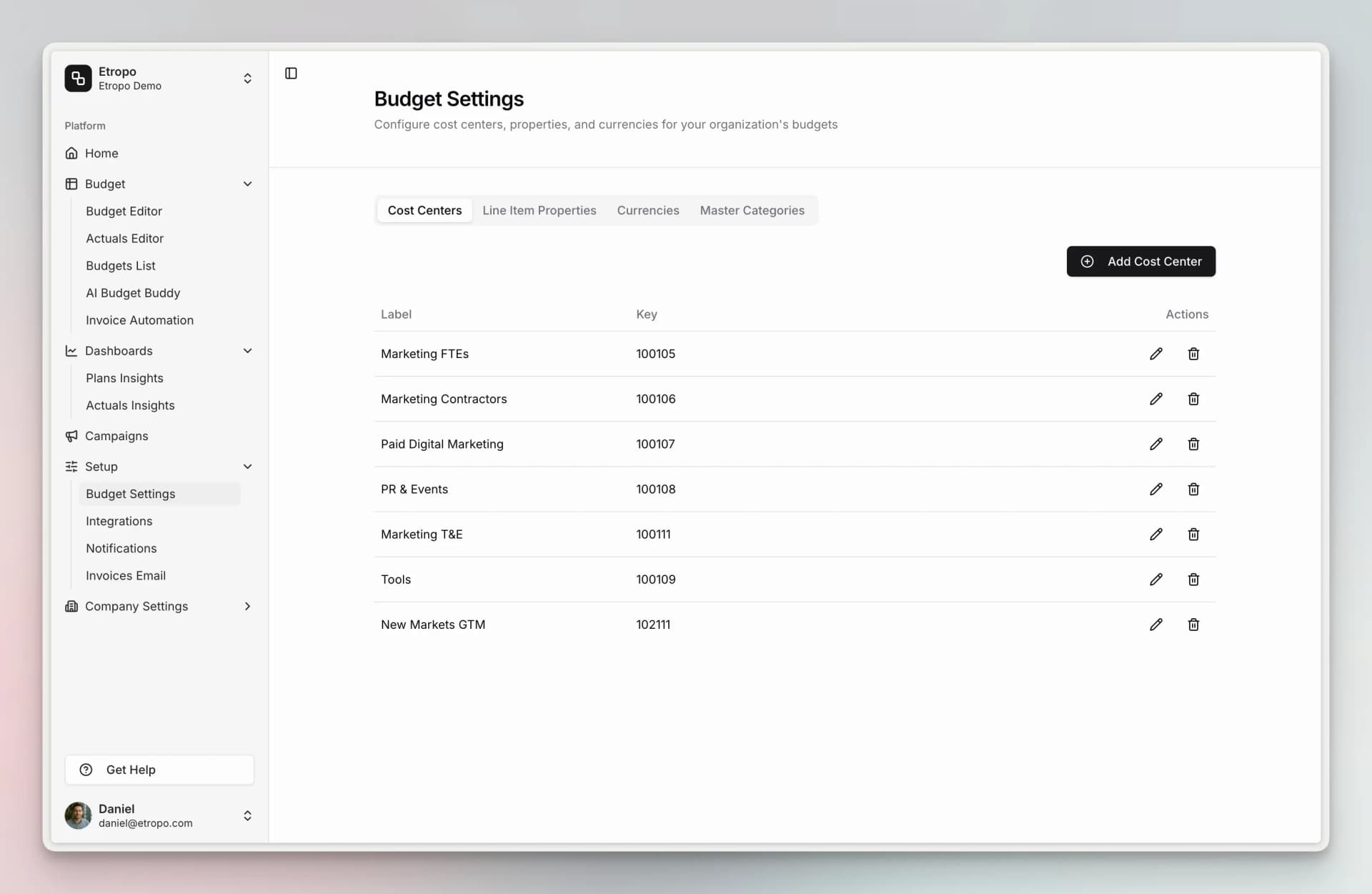
Get your current cost center list and check if they're self-explanatory. If not, ask finance for definitions and examples.
Review the cost center structure. A new marketing strategy might require consolidation of old cost centers and addition of new ones. For example, you might have separate cost centers for “Social Media Ads”, “Search Ads”, and “Display Ads” from years ago that could be consolidated into a single “Digital Ads” cost center.
When planning such changes or adding new cost centers, clarify with finance:
- Can you propose cost center updates? (usually it's possible once a year in Q4)
- What's the proposal process and who needs to approve the changes
While cost centers are crucial for finance reporting, don't let them dictate how you categorize expenses in your day-to-day marketing budget management.
Currencies and exchange rates
Your marketing budget needs a clear approach to handling multiple currencies, especially if you're working with international campaigns or contractors.
First, confirm your reporting currency with finance. This is your company's primary currency where all business metrics are recorded - both revenue and costs. Even if specific line items (e.g. software or contractors) are being paid in a different currency, they will be converted to the primary reporting currency at a given exchange rate.
Companies typically follow one of two approaches for handling exchange rates:
- Company-Wide Fixed Rates - Finance sets standard exchange rates for the entire fiscal year, and all departments must use these rates for budget planning. You don't take the risk of exchange rate fluctuations - it's managed at the company level by the finance team. Your job is simply to assign the correct original currency to each line item.
- Market-Based Flexible Rates - Departments use current market rates and manage currency risk independently. In this case, add at least a 3-5% buffer to your budgeted amounts to protect against rate fluctuations.
Regional tax requirements
When adding line items, you might need additional properties related to tax management, such as:
- VAT? (yes/no)
- Vendor's tax registration region (EU/US/Canada/Other)
- Certificate of residence needed? (yes/no)
Planning horizon
While you're focused on next year's budget, check if your company requires multi-year projections:
- Some companies need 3-year plans for strategic planning
- Others require 5-year projections for board or investor relations
- You might need different detail levels (detailed Year 1, high-level Years 2-3)
Team compensation planning
Team salaries and bonuses often represent a significant portion of your marketing budget. Check with your HR and finance teams how to handle:
- Your salary - should it be a separated line item in the marketing budget (or is it covered in the Board/Leadership budget)
- Annual salary increases - whether to plan as one bulk line item for the whole team or individually per role. Is there any extra approval process you should follow?
- Performance bonuses - if marketing budget can include them or if they're managed centrally by HR
- Sales provisions - especially for roles like Partner Marketing that might have revenue-based compensation
Frequently asked questions
What does finance need from a marketing budget?
- A submission in their template with their required columns (cost center and ID, description, amount, currency, payment terms, vendor details), every line item mapped to a cost center and GL account, tax properties where relevant, and the level of detail they asked for. Plan in your own category structure and export into theirs.
What is a cost center in a marketing budget?
- A tracking code finance uses to group expenses for the general ledger, for example MKTG-ACQ-DIG (103-2001) for digital advertising or MKTG-STAFF-EU for employee costs. Every marketing line item must carry one so the budget consolidates into company reporting. Cost centers are finance’s labels; they should not dictate your day-to-day categories.
How do I handle multiple currencies in a marketing budget?
- Confirm the reporting currency first. Then ask which exchange-rate policy the company uses: company-wide fixed rates set by finance for the fiscal year (you assign the original currency per line item and carry no rate risk) or market-based rates managed per department (add at least a 3 to 5% buffer to foreign-currency line items).
Should the CMO’s salary be in the marketing budget?
- It depends on the company. Some carry the CMO in the leadership budget, others in marketing headcount. Ask HR and finance early, along with how annual raises are planned (one bulk line or per role), whether bonuses sit in the marketing budget or centrally, and how revenue-based compensation for roles like partner marketing is handled.
What is a certificate of residence and why does marketing care?
- A document proving a vendor’s tax residency. When an EU-registered company buys services, typically software, from a non-EU vendor without one, it can owe an additional 20% in withholding tax. In smaller companies marketing ends up chasing vendors for it, so add it as a yes/no property on vendor line items.
Ready to implement your marketing budget?
Use etropo to automate your budget tracking, variance analysis, and reporting.