Marketing Automation Tools: Pricing Comparison (2026)
What marketing automation actually costs — at your contact volume, not just the starting price.
We researched the pricing pages, calculators, and review scores of 11 leading marketing automation platforms so you can see exactly what you'll pay at 1K, 10K, and 50K contacts — and how it fits into your overall marketing spend.
16 Tools Compared | Last updated: March 2026
| Tool | 1K contacts | 10K contacts | 50K contacts | Pricing Model | Free Plan | Monthly Plan | Self-Service | Rating |
|---|---|---|---|---|---|---|---|---|
| HubSpot Marketing Hub | $20/mo | $970/mo | $3960/mo | Per marketing contact | 4.4 | |||
| ActiveCampaign | $49/mo | $189/mo | $479/mo | Per contact | 4.5 | |||
| Adobe Marketo Engage | Custom | Custom | Custom | Custom (contact database size + feature tier) | 4.1 | |||
| Salesforce Marketing Cloud Account Engagement | $1250/mo | $1250/mo | $4000/mo | Per prospect record (annual, tiered) | 4.2 | |||
| Keap | $299/mo | $759/mo | Contact sales | Per contact (all-inclusive single plan) | 4.0 | |||
| Ontraport | $79/mo | $297/mo | Custom | Per contact | 4.5 | |||
| Ortto | $199/mo | $509/mo | Custom | Per contact | 4.5 | |||
| HighLevel | $97/mo | $97/mo | $97/mo | Per account (flat rate, unlimited contacts) | 4.5 | |||
| Customer.io | $100/mo | $145/mo | $1000/mo | Per profile (with usage-based overages) | 4.4 | |||
| Encharge | $79/mo | $279/mo | $550/mo | Per contact (subscriber-based) | 4.7 | |||
| Mautic | $0/mo | $0/mo | $0/mo | Free (self-hosted) / Per-instance (managed cloud) | 3.8 | |||
| Braze | Custom | Custom | Custom | Custom (MAU-based + message volume) | 4.6 | |||
| Iterable | Custom | Custom | Custom | Custom (contact database + message volume) | 4.3 | |||
| Attentive | $650/mo | $3000/mo | Custom | Per message + platform fee (custom) | 4.8 | |||
| Bloomreach Engagement | Custom | Custom | Custom | Custom (module-based + usage) | 4.5 | |||
| Klaviyo | $45/mo | $150/mo | $720/mo | Per active profile | 4.6 |
Marketing Automation Tools — Detailed Breakdown
How each tool's pricing actually works, with budget context.
HubSpot Marketing Hub is the most widely adopted all-in-one marketing automation platform for B2B teams. It connects email, landing pages, forms, social, and automation directly to HubSpot CRM — giving marketing and sales a single source of truth. The Professional tier unlocks real automation workflows, A/B testing, and smart content; Enterprise adds predictive scoring and custom objects.
Pricing Model
Price Range
$20–$3,600/mo
Free Plan
Free CRM with basic email, limited automation, HubSpot branding on all assets
HubSpot charges per "marketing contact" — only contacts you actively email or automate, not your entire CRM database. Starter ($20/mo) covers 1,000 marketing contacts but lacks multi-step workflows. Professional ($890/mo) is where real automation begins: it includes 2,000 contacts, workflow automation, A/B testing, and smart content — but requires a mandatory $3,000 onboarding fee and annual commitment. Additional contacts cost $100/mo per 5,000 on Professional. At 10,000 contacts, Professional runs ~$970/mo (base + 8K extra). Enterprise ($3,600/mo) adds predictive lead scoring, custom objects, and team partitioning. Annual billing saves 10%.
Pros
- Seamless native CRM integration — marketing data flows to sales without any syncing setup
- HubSpot Academy, extensive documentation, and large partner ecosystem for ramp-up
- Professional tier unlocks full multi-step automation, A/B testing, and revenue attribution
Cons
- Professional ($890/mo) + mandatory $3,000 onboarding fee is a steep initial commitment
- At scale, HubSpot can consume 10–20% of a mid-market company's entire marketing budget
- Full automation requires annual contract — no month-to-month option at Professional tier
ActiveCampaign is the leading SMB marketing automation platform, known for its visual workflow builder, built-in CRM, and 900+ pre-built automation templates. With strong deliverability and deep e-commerce integrations, it powers marketing for 150,000+ businesses. The Plus plan unlocks CRM, lead scoring, and landing pages — everything most B2B and e-commerce teams need without enterprise pricing.
Pricing Model
Price Range
$49–$479/mo
Free Plan
No — 14-day free trial
ActiveCampaign Plus charges per total contact count across four tiers. At 1,000 contacts, Plus is $49/mo (annual billing); at 10,000 contacts, it scales to $189/mo. The Plus plan adds CRM, lead scoring, and landing pages — features most B2B teams consider essential. The Pro plan ($79/mo at 1K) adds predictive sending, attribution reporting, and split automation paths. Annual billing is required for advertised rates; monthly billing adds ~25%. Contacts include all records including unsubscribed, which can inflate your tier. ActiveCampaign raised prices in 2024–2026, making it critical to audit your active vs. inactive contacts.
Pros
- Best-in-class visual automation builder with 900+ pre-built automation templates
- Built-in CRM with lead scoring for seamless marketing-to-sales handoffs
- Strong deliverability reputation and detailed email performance analytics
Cons
- No free plan — 14-day trial only before payment required
- Advertised prices require annual billing; monthly billing adds ~25% to all tiers
- CRM, lead scoring, and landing pages locked behind Plus plan ($49+/mo at 1K)
Adobe Marketo Engage is the enterprise-grade marketing automation platform for large B2B organizations. Part of Adobe Experience Cloud, it handles lead management, account-based marketing, multi-touch attribution, and advanced analytics at scale. Used by Fortune 500 companies and enterprise marketing ops teams, Marketo is the gold standard for complex, multi-stakeholder B2B sales cycles.
Pricing Model
Price Range
From $895/mo
Free Plan
No
Marketo Engage pricing is entirely custom and negotiated directly with Adobe, starting around $895–$3,200/mo depending on database size and feature tier (Growth, Select, Prime, Ultimate). There are no self-service plans — a demo request and sales process are required for all tiers. Implementation typically costs $10,000–$50,000+ through a certified Marketo partner and takes 60–90 days. Annual contracts are standard, with typical mid-market commitments of $15,000–$100,000+/year. Cloud pricing is based on total database records (all contacts, not just those being marketed to), which leads to higher base costs than per-marketed-contact tools like HubSpot.
Pros
- Most powerful lead management and nurturing for complex B2B sales cycles with long deal timelines
- Account-based marketing (ABM) and account-level scoring for enterprise B2B
- Deep Adobe Experience Cloud integration enabling true multi-channel attribution
Cons
- No self-service pricing — all tiers require sales process and contract negotiation
- Implementation costs $10,000–$50,000+ and typically takes 2–4 months
- Requires dedicated marketing ops staff to maintain; not suitable for lean teams
Salesforce Marketing Cloud Account Engagement (formerly Pardot) is the native B2B marketing automation suite built into the Salesforce ecosystem. It handles lead nurturing, scoring, and routing for Salesforce CRM users — providing seamless marketing-to-sales handoffs without third-party integration. Best for teams already deeply embedded in Salesforce who need marketing automation without a separate platform.
Pricing Model
Price Range
From $1,250/mo
Free Plan
No
Pardot charges annually per number of "prospect" records across four plans: Growth ($1,250/mo, 10K prospects), Plus ($2,500/mo, 10K), Advanced ($4,000/mo, 10K), and Premium ($15,000/mo, 75K). The minimum contract covers 10,000 prospects regardless of actual list size — making it expensive even for small B2B teams. All plans require annual commitment with no monthly option. No free plan or trial is available. Professional Salesforce consulting typically adds $5,000–$20,000 in setup costs. Salesforce CRM licenses are additional ($75–$300/user/mo) if not already owned — a critical total cost consideration.
Pros
- Native Salesforce CRM sync — real-time, bidirectional, no integration setup or data mapping
- Engagement Studio (visual campaign builder) for sophisticated multi-stage nurture paths
- Built-in B2B Analytics with Salesforce report builder for pipeline attribution
Cons
- 10,000-prospect minimum means $1,250/mo even for lists under 1,000 — expensive to start
- No free plan or trial — significant budget commitment before seeing any ROI
- Setup requires Salesforce admin expertise plus $5,000–$20,000 in consulting fees
Keap (formerly Infusionsoft) is an all-in-one CRM and marketing automation platform designed specifically for small businesses. It combines CRM, email marketing, e-commerce, payments, and automation in a single platform with a simple all-inclusive pricing model — no feature gating between tiers. Popular with service businesses, coaches, and consultants managing their entire customer lifecycle in one tool.
Pricing Model
Price Range
From $249/mo
Free Plan
No — 14-day free trial
Keap uses a single all-inclusive plan where every feature is available at every contact tier. The base plan is $299/mo (monthly) or $249/mo (annual) for 1,500 contacts and 2 users. As contacts grow, Keap adds blocks at a stairstep rate: the first 1,000 extra contacts cost $36/mo, the next 2,500 cost $84/mo, the next 5,000 cost $150/mo, and the 5K–10K block adds $240/mo — putting 10,000 contacts at approximately $759/mo annually. Required implementation coaching packages start at $499. Annual billing saves 17%. Each additional user beyond the included 2 costs $39/mo.
Pros
- All features included at every price point — no plan-based feature gating to navigate
- Strong built-in payments, e-commerce, and appointment scheduling for service businesses
- Visual automation builder with pipeline management and automated follow-up sequences
Cons
- Expensive at scale — $759/mo for 10K contacts vs. $189/mo on ActiveCampaign Plus
- Required implementation coaching ($499+) adds upfront cost before using the platform
- Interface and UX feel dated compared to modern alternatives like ActiveCampaign or Ortto
Ontraport is a business automation platform combining CRM, email marketing, landing pages, membership sites, and e-commerce for SMBs. Known for its deep membership site and online course capabilities, Ontraport is popular with coaches, consultants, and online businesses that sell information products. It offers strong customer support with unusually fast response times praised consistently across reviews.
Pricing Model
Price Range
$79–$497/mo
Free Plan
No — 14-day free trial
Ontraport offers four plans based on contact count: Basic ($79/mo, 1,000 contacts), Plus ($147/mo, 2,500 contacts), Pro ($297/mo, 10,000 contacts), and Enterprise ($497/mo, 20,000 contacts). Pricing above 20,000 contacts is custom. Each additional user seat costs $46/mo on all plans. Annual billing saves approximately 15%. Extra contacts and email volume are available as add-ons ($99/mo per 100,000 contacts or emails). At 50,000 contacts, Ontraport requires custom Enterprise pricing. A 14-day free trial is available on all plans — no credit card required.
Pros
- Built-in membership sites, online courses, and client portals — rare among automation tools
- All-in-one platform with payments, affiliate tracking, and landing pages included
- Exceptional customer support reputation with fast response times across reviews
Cons
- Lower contact limits per plan than most competitors at the same price point
- Steeper learning curve than tools like ActiveCampaign due to dense feature set
- Interface can feel overwhelming for new users unfamiliar with all-in-one platforms
Ortto (formerly Autopilot) is a modern marketing automation and analytics platform that combines customer data, journey automation, and built-in analytics in one tool. Particularly strong at multi-channel journeys across email, SMS, in-app messaging, and push notifications — with native analytics that eliminate the need for a separate BI tool. Popular with growth-stage SaaS and D2C brands.
Pricing Model
Price Range
From $199/mo
Free Plan
No — 14-day free trial
Ortto offers three paid plans: Starter ($199/mo monthly or ~$169/mo annual for 5,000 contacts), Professional ($509/mo annual for 10,000 contacts), and Business ($849/mo annual for 10,000 contacts with advanced analytics). Enterprise pricing is custom. A critical note: the Starter minimum covers 5,000 contacts — teams with under 5K contacts still pay $199/mo with no smaller entry tier. Professional and higher require annual commitment; only Starter allows month-to-month. The Professional tier unlocks A/B testing, custom reporting, and predictive analytics. Enterprise contact volumes are available at custom pricing.
Pros
- Native analytics dashboard eliminates the need for a separate BI or reporting tool
- Best-in-class visual customer journey builder for multi-channel campaigns
- Built-in CDP capabilities for unified customer profiles across channels
Cons
- Minimum Starter plan is $199/mo even for very small lists under 5,000 contacts
- Professional and Business tiers require annual commitment — no monthly billing
- Fewer native e-commerce integrations than Klaviyo or Omnisend for online stores
HighLevel (GoHighLevel) is an all-in-one marketing platform designed for marketing agencies and their clients. It combines CRM, email, SMS, funnel builder, website builder, scheduling, review management, and white-label capabilities — with unlimited contacts across all plans. Agencies use it to run their entire client base from a single platform without paying per-contact fees.
Pricing Model
Price Range
$97–$497/mo
Free Plan
No — 14-day free trial
HighLevel prices by account type, not contact count — making it uniquely cost-effective for high-volume contact databases. Starter ($97/mo) allows 3 sub-accounts, suitable for solo operators or small agencies. Unlimited ($297/mo) removes the sub-account cap for agencies with 4+ clients. SaaS Pro ($497/mo) adds automated client onboarding and white-label SaaS capabilities. Contacts are unlimited on every plan. Usage-based fees apply separately for SMS, phone calls, email sends, and AI features — billed via wallet credits (typically $10–$100/mo for average usage). Annual billing saves 20% across all plans.
Pros
- Unlimited contacts on all plans — price never increases as your contact database grows
- White-label capabilities: resell as your own branded SaaS platform to clients
- All-in-one: CRM, funnels, SMS, email, reviews, and scheduling in a single account
Cons
- Steep initial learning curve — dozens of features can overwhelm first-time users
- Email deliverability is a known weakness; built-in email infrastructure is inconsistent
- Best value for agencies managing multiple clients — overkill and less intuitive for single businesses
Customer.io is a developer-friendly marketing automation platform built for product-led SaaS and app companies. It excels at event-based behavioral triggers, multi-channel messaging (email, SMS, push, in-app), and complex segmentation based on real-time user actions and product events. Beloved by growth and product teams for its API-first architecture and ability to trigger automation from any custom event.
Pricing Model
Price Range
From $100/mo
Free Plan
No — 14-day free trial
Customer.io Essentials is $100/mo and covers up to 5,000 profiles and 1 million email sends/mo. Beyond 5,000 profiles, overages are $0.009/profile/mo — at 10,000 profiles, expect $100 + $45 in overages = $145/mo. Premium ($1,000/mo billed annually) unlocks custom profile volumes, a dedicated Customer Success Manager, and premium integrations including Salesforce and data warehouse connections. The jump from Essentials to Premium is a 7x price increase, making Customer.io most cost-effective for teams under 5,000 profiles. Enterprise pricing is custom for large volumes. A 14-day free trial and startup program (up to 12 months free) are available.
Pros
- Best event-based behavioral segmentation and real-time triggers in the mid-market
- API-first architecture integrates seamlessly with any product data source or data warehouse
- Multi-channel support: email, push, SMS, in-app, and webhooks in a single automation flow
Cons
- Essentials plan capped at 5,000 profiles — overages accumulate quickly for growing products
- 7x price jump from $100/mo (Essentials) to $1,000/mo (Premium) with little middle ground
- Higher learning curve for non-technical teams; complex setup often requires developer involvement
Encharge is a marketing automation platform designed for SaaS companies, digital businesses, and agencies. It combines email campaigns, behavior-based automation flows, and deep native integrations with HubSpot, Salesforce, Stripe, and Segment. Positioned as a powerful mid-tier option between basic email tools and enterprise platforms, with unlimited emails and users across all plans.
Pricing Model
Price Range
$79–$879/mo
Free Plan
No — 14-day free trial
Encharge offers Growth (from $99/mo monthly or $79/mo annual for 2,000 contacts) and Premium (from $159/mo monthly or $129/mo annual for 2,000 contacts) plans. Both include unlimited email sends and unlimited users — a standout value versus per-seat pricing tools. The annual pricing range is $79–$550 for Growth and $129–$879 for Premium, scaling with subscriber count. At 10,000 contacts on Growth, expect approximately $279/mo annually. Premium unlocks deep CRM integrations with HubSpot, Salesforce, and Shopify. A 14-day free trial is available. For over 50,000 subscribers, custom pricing is available via their support team.
Pros
- Unlimited emails and users on all plans — no per-seat fees or send-limit surprises
- Deep CRM integrations (HubSpot, Salesforce, Stripe, Segment) on Premium plan
- Intuitive flow builder with fast performance praised across user reviews
Cons
- Smaller ecosystem and fewer native integrations than ActiveCampaign or HubSpot
- Premium plan ($129+/mo) required for major CRM integrations like HubSpot and Salesforce
- Less brand recognition means fewer third-party resources, tutorials, and community templates
Mautic is the world's leading open-source marketing automation platform, used by 200,000+ businesses globally. Self-hosted deployments are completely free with full access to email campaigns, multi-step automation, landing pages, and CRM integrations — with no contact limits or per-seat fees. Cloud-hosted managed versions from certified partners start around $150/mo. Best for technical teams that want enterprise-level features with zero per-contact pricing.
Pricing Model
Price Range
From $0/mo
Free Plan
Self-hosted only; requires server setup, SMTP provider, and ongoing technical maintenance
Mautic's core platform is free, open-source, and self-hostable with no contact limits, no per-seat fees, and no feature gating of any kind. The primary cost is server hosting ($20–$100/mo on AWS, DigitalOcean, or similar) plus developer/admin time for setup and ongoing maintenance (typically 4–20 hours/month). A separate SMTP provider (SendGrid, AWS SES, Mailgun) is required for email sending, adding $10–$100/mo depending on volume. Cloud-managed Mautic from certified partners (Acquia Mautic, Leuchtfeuer) starts around $150–$400/mo and handles hosting, updates, and support. Mautic 6.x (2026) added AI-powered features and a significantly improved interface.
Pros
- Free — no per-contact fees at any list size, even at 500K+ contacts
- Full enterprise feature set: automation, landing pages, CRM, forms, social monitoring
- Complete data ownership and privacy compliance (GDPR, HIPAA-ready on self-hosted infrastructure)
Cons
- Requires developer/technical resources to self-host, configure, and maintain
- Deliverability requires separate SMTP provider setup (SendGrid, AWS SES) at additional cost
- Lower review scores reflect UX complexity; steeper learning curve than commercial alternatives
Braze is an enterprise customer engagement platform powering real-time, personalized messaging across email, SMS, push, in-app, and web for the world's largest consumer brands. Used by Airbnb, HBO, Headspace, and Postmates for behavior-driven engagement at massive scale. Its Liquid templating engine and Canvas flow builder set the industry standard for multi-channel journey orchestration.
Pricing Model
Price Range
From $5,000/mo
Free Plan
No
Braze pricing is entirely custom and non-public, negotiated annually with their sales team. Contracts typically range from $60,000–$200,000/year ($5,000–$16,667/mo) for mid-market deployments, scaling to $1,000,000+/year for large enterprise. Pricing factors include monthly active users (MAUs), message volume across channels (email, SMS, push, in-app, content cards), and selected platform edition (Core, Pro, Enterprise). No self-service option exists. Implementation through a Braze Solutions Partner typically costs $20,000–$100,000+. Multi-year contracts and competing offers can achieve 20–30% below list pricing, especially when negotiating at quarter-end.
Pros
- Best-in-class multi-channel journey orchestration across email, SMS, push, in-app, and web in one canvas
- Real-time audience segmentation based on live behavioral events — no batch processing delays
- Liquid templating engine enables deep, dynamic personalization at enterprise message volumes
Cons
- No public pricing and no self-service — sales engagement required for all tiers
- Annual contracts starting at $60K+/year put it out of reach for most SMBs and mid-market teams
- Complex implementation requiring certified Braze Solutions Partner or dedicated technical resources
Iterable is a growth marketing platform built for enterprise B2C companies needing sophisticated multi-channel campaign orchestration. It powers personalized email, SMS, push, in-app, and web messaging for brands like DoorDash, Priceline, and Box. Known for its flexible data model, Workflow Studio visual builder, and ability to handle complex, data-intensive cross-channel customer journeys.
Pricing Model
Price Range
From $2,500/mo
Free Plan
No
Iterable pricing is custom-quoted and not publicly disclosed. Based on buyer-reported data, the median annual contract is approximately $32,000/year ($2,667/mo), with large enterprise deployments reaching $220,000+/year. Pricing is determined by contact database size, message volume, and selected tier (Growth, Scale, Enterprise). No self-service or free trial is available — a demo and sales process are required for all tiers. Implementation costs $5,000–$20,000 through an Iterable partner. Annual billing is standard. Multi-year commitments and competitive benchmarks typically achieve 15–30% discounts from list pricing.
Pros
- Highly flexible custom event schema — maps to any data structure without rigid field requirements
- Workflow Studio enables sophisticated multi-channel journeys with real-time conditional branching
- Strong product catalog and recommendation features for personalized cross-sell and upsell messaging
Cons
- No self-service or transparent pricing — sales engagement required for every tier
- Minimum viable deployment starts around $32K/year — not viable for SMBs or early-stage companies
- Steeper setup and learning curve than ActiveCampaign or HubSpot for initial team onboarding
Attentive is the leading AI-powered SMS and email marketing platform for e-commerce brands. It specializes in permission-based text message marketing with deep Shopify, BigCommerce, and DTC integrations. Attentive's AI automatically optimizes send times, message content, and audience segmentation to maximize revenue from mobile channels, making it the go-to platform for brands where SMS is a primary revenue driver.
Pricing Model
Price Range
From $450/mo
Free Plan
No
Attentive doesn't publish pricing and requires a sales call for a custom quote. Based on reported market data, small e-commerce brands (under 5K SMS subscribers) pay approximately $450–$650/mo for platform access plus per-message fees. Growing brands sending 50,000 SMS/month typically pay $2,500–$3,500/mo. Enterprise deployments (200K+ messages/month) range from $10,000–$15,000/mo. Attentive charges for both outbound messages and inbound replies — every customer interaction counts toward your bill. Carrier compliance fees (10DLC, A2P registration) add ongoing costs. Contracts are annual with a minimum quarterly spend commitment.
Pros
- Rated #1 SMS marketing platform by G2 with 4.8/5 Capterra score from 108 reviews
- AI-powered send-time optimization and message content recommendations built into the platform
- Deep e-commerce integrations: Shopify flows, cart abandonment, browse, post-purchase all pre-built
Cons
- No public pricing and no self-service — custom quote required for all customers
- Both outbound messages AND inbound replies are billed — costs scale faster than list size alone
- Annual contract with minimum quarterly spend commitment — expensive exit if needs change
Bloomreach Engagement (formerly Exponea) is an enterprise CDP and marketing automation suite built for large-scale e-commerce and retail. It combines a real-time customer data platform, omnichannel automation, AI-powered personalization, and advanced analytics in a single tool. Used by Marks & Spencer, Bosch, Pandora, and hundreds of global retail and e-commerce brands to drive revenue through unified data-driven marketing.
Pricing Model
Price Range
From $4,167/mo
Free Plan
No
Bloomreach uses a module-based pricing model where you pay for the specific capabilities you need (email, SMS, web personalization, product recommendations, analytics) plus usage fees that decrease at volume. Total platform cost starts at approximately $50,000/year ($4,167/mo) for essential modules, scaling to $200,000+/year for full enterprise deployments. All pricing requires a custom quote from their sales team — nothing is published. Implementation requires a certified Bloomreach partner and typically costs $15,000–$50,000+ with 3–6 months of onboarding. All base plans include access to the customer data engine, standard support, and documentation.
Pros
- Unified CDP + marketing automation in one platform — eliminates the need for a separate data warehouse
- AI-powered product recommendations and real-time personalization purpose-built for retail scale
- Advanced revenue analytics and attribution reporting out of the box — no separate BI tool required
Cons
- $50K+/year minimum makes it impractical for brands under $20M in annual e-commerce revenue
- Complex implementation requiring certified Bloomreach partner — typically 3–6 months to full deployment
- Feature depth demands dedicated marketing ops and analytics resources to fully utilize
Klaviyo is the go-to email and SMS marketing automation platform for e-commerce. It integrates deeply with Shopify, WooCommerce, and BigCommerce for behavior-based automation — abandoned cart, browse abandonment, post-purchase, win-back — with direct revenue attribution on every flow and campaign. As of 2025, Klaviyo expanded beyond email into a full e-commerce data platform with predictive analytics, customer lifetime value scoring, and SMS.
Pricing Model
Price Range
$45–$720/mo
Free Plan
Up to 250 contacts, 500 email sends/mo, limited features
Klaviyo prices by total active profiles — all subscribed contacts in your account, whether emailed recently or not. Email-only at 1,000 profiles is $45/mo; at 10,000 it's $150/mo; at 50,000 it's $720/mo. Adding SMS creates a combined Email + SMS plan at higher rates. As of early 2025, Klaviyo bills on all active profiles rather than just contacts emailed in a given month, which increased costs for brands with large unengaged lists. Revenue attribution is built in — every email and SMS flow shows direct revenue influenced, making ROI reporting straightforward. A free plan covers up to 250 contacts with 500 email sends/mo.
Pros
- Best-in-class Shopify and e-commerce integrations with pre-built automation flows
- Built-in revenue attribution — every email and SMS flow shows direct revenue influenced
- Predictive analytics: CLV scoring, churn risk, next purchase date all computed automatically
Cons
- Bills on all active profiles, not just contacted ones — costs grow faster than actual list engagement
- Significantly more expensive than general-purpose tools (ActiveCampaign, MailerLite) at scale
- Overkill and overpriced for non-e-commerce use cases — B2B SaaS teams get little value
Marketing Automation Pricing FAQ
Common questions about marketing automation costs, budgeting, and how to get the most value from your tools.
How much does marketing automation software cost in 2026?
- This page compares 16 tools. At 1K contacts the median is $97/mo, the HighLevel flat rate. ActiveCampaign costs $49/mo and Klaviyo $45/mo. Pardot at $1,250/mo pulls the average up to $238/mo. At 10K contacts the median is $297/mo. At 50K contacts only 8 tools publish a price, with a median of $720/mo. Marketo, Braze, Iterable and Bloomreach quote every tier through sales.
Contact tier Tools with public pricing Lowest Median Average Highest 1K contacts 12 of 16 $0/mo (Mautic) $97/mo $238/mo $1,250/mo (Pardot) 10K contacts 12 of 16 $0/mo (Mautic) $297/mo $637/mo $3,000/mo (Attentive) 50K contacts 8 of 16 $0/mo (Mautic) $720/mo $1,476/mo $4,000/mo (Pardot) Mautic ($0) is open-source and requires self-hosting. Marketo, Braze, Iterable, and Bloomreach require a sales quote at all tiers and are excluded from the averages and medians above.
How can I reduce marketing automation costs?
Five ways to cut the cost:
- Check which features you use: ActiveCampaign Plus at $49/mo covers 80% of what most teams use in HubSpot Professional at $890/mo
- Move to flat-rate pricing if your list is large: HighLevel costs $97/mo for unlimited contacts
- Self-host Mautic if you have a developer: hosting costs $20–$100/mo against $500–$2,000/mo for commercial tools
- Pay annually: ActiveCampaign, HubSpot and Keap take 15–20% off
- Remove inactive contacts to drop a pricing tier and save $50–$500/mo
What percentage of my marketing budget should go to marketing automation tools?
- Marketing automation usually takes 10–20% of the B2B martech budget, or 2–6% of total annual marketing spend. On a $100K budget, that is $5,000–$10,000 a year, or $417–$833/mo. Teams with sales cycles of 6 months or more often spend 15–20% of the tech budget on it. HubSpot Professional at $890/mo alone takes 10.7% of a $100K budget. Start with ActiveCampaign Plus at $49/mo and move up as the pipeline grows.
What is the best free marketing automation tool?
- Mautic is the most capable free option. It has no contact limits, but you host and maintain it yourself. Without a developer, HubSpot's free CRM gives you basic email automation, forms and 1-step workflows. Kit's free plan allows 10,000 subscribers with 1 automation. MailerLite's free plan allows 500 contacts and 12K emails a month with basic sequences. Free plans stop at 1–3 steps. Commercial workflows run 5–20 steps with branching.
When should I upgrade from a basic email tool to a full marketing automation platform?
The cheapest full behavioral automation is ActiveCampaign Plus at $49/mo for 1K contacts. Upgrade when one of these applies:
- You follow up by hand on form fills, link clicks or pricing page visits more than once a week
- Sales cannot tell hot leads from cold ones because marketing does not score and route them
- You cannot see which campaigns influenced closed revenue
- You need separate nurture sequences for different segments at the same time
- Your sales cycle has 3 or more stages but everyone gets the same content
Which marketing automation tools are best for startups on a budget?
Marketo, Pardot and Ortto take 3–6 months to implement, so most startups should wait until product-market fit. Five options that fit a startup budget:
- ActiveCampaign Starter at $15/mo for 1K contacts is the cheapest real multi-step automation
- HubSpot Starter at $20/mo adds basic automation and landing pages to the free CRM
- Encharge at $79/mo for 2K contacts, billed annually, serves SaaS companies with Stripe and Segment integrations
- Customer.io Essentials at $100/mo sends messages that product events trigger
- Mautic is free if a developer can set it up
Related Budget Templates
Use these templates to plan your full marketing budget with the right tool allocations.
Know the costs?
Now plan your actual budget.
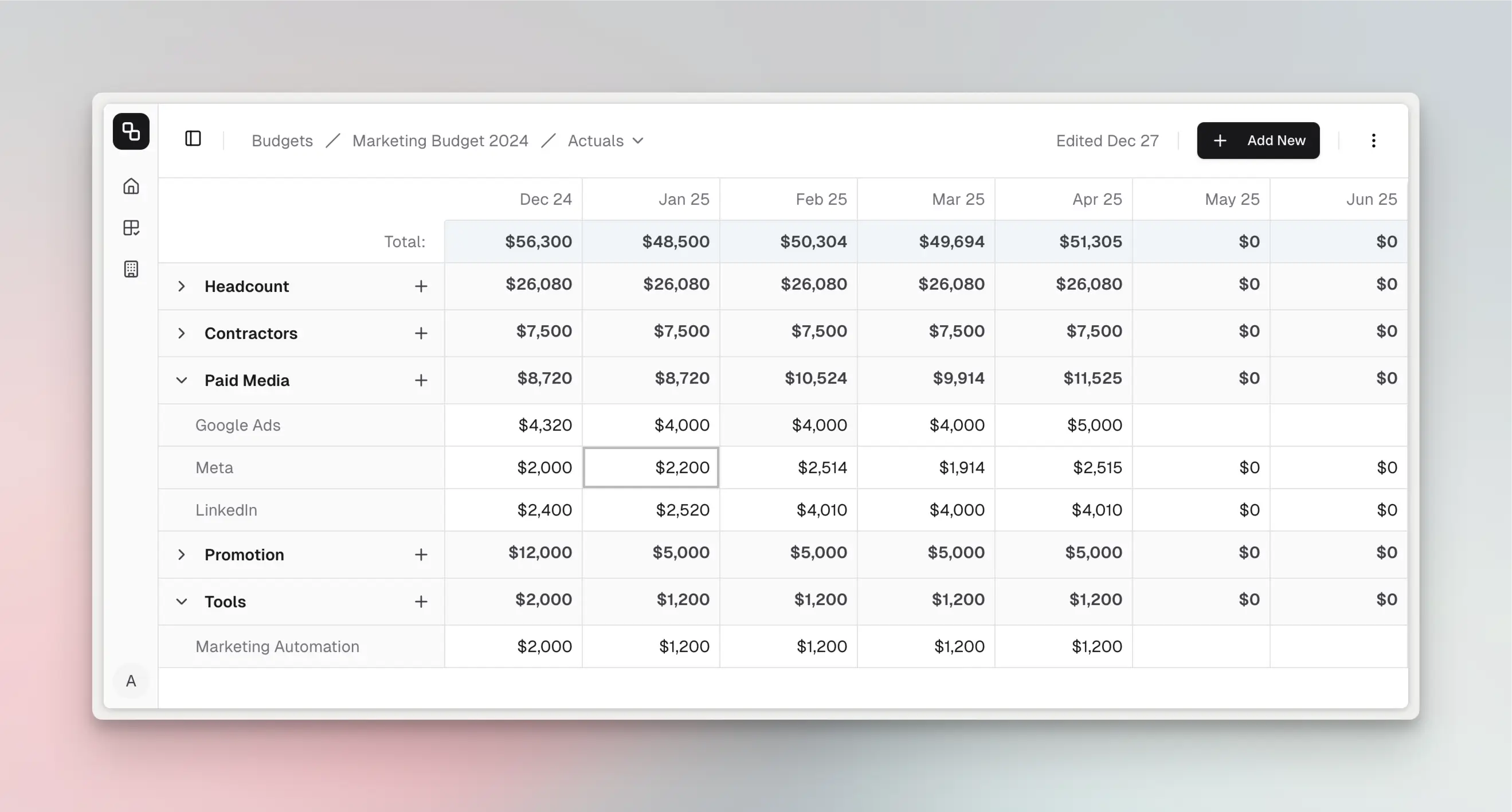
Build a complete marketing budget with marketing automation tools and every other channel - in one place.