
How to Get Your Marketing Budget Approved: Presenting to the CFO and Board
Written by
CMO with 10+ years experience managing marketing budgets at B2B SaaS companies
Guide chapters (12)
A marketing budget gets approved when the CEO and board see the growth case in six charts, finance receives every line item in their cost-center format, and the six questions they always ask are answered before they are asked. This chapter walks through the self-review, the internal review of your team's proposals, what each stakeholder group needs, and the questions to prepare for.
Analyze your own budget first: six must-have charts
Before you submit your budget for approval, you need to analyze the numbers on your own. Go through the list below, and if you find any concerns, update the budget plan. These are the questions that might arise from your CEO, CFO, CRO or the Finance Team in general. Copy-paste these charts into the budget pitch deck. Give proactively the answers to your stakeholders, before they will ask about them.
| Chart name | Why it's important |
|---|---|
| Total Budget vs Conversions YoY | Budget growth must correlate with conversion growth to justify increased spending |
| Total Budget QoQ and H1 vs H2 | Shows if budget fluctuations align with business seasonality and planned activities |
| Budget for New vs Existing Initiatives | Reveals risk level - too many new initiatives may decrease confidence in hitting targets |
| Total Budget Breakdown by Category | Highlights growth in key categories. Be ready to defend if headcount (fixed cost) shows highest growth |
| Total Budget Breakdown by Goal | For fast-growing companies, acquisition should be the dominant spending category |
| Marketing Budget as % of Revenue | Should stay between 5-20% of revenue and decrease in time. If not, justify why your plan isn't scalable |
Must-have marketing budget charts. Each one answers a question a stakeholder would otherwise ask in the review.
Review your team’s proposals
The line item review requires a structured approval approach. Your team must use clear statuses as line item property to track progress and enable efficient collaboration. Use this status flow to manage all budget line items:
Item still needs work or adjustments
Ready for marketing leader's review
Item accepted into budget plan
Item needs major revision or removal
Focus on evaluating each category owner's submissions thoroughly. Pay special attention to items that seem disconnected from team or company targets. For example, if your paid media specialist proposes a 200% budget increase while projecting only 50% conversion growth, that calls for discussion.
When rejecting or significantly modifying budget items, provide clear feedback through comments. This helps team members understand expectations and adjust their proposals effectively without requiring meetings for every change.
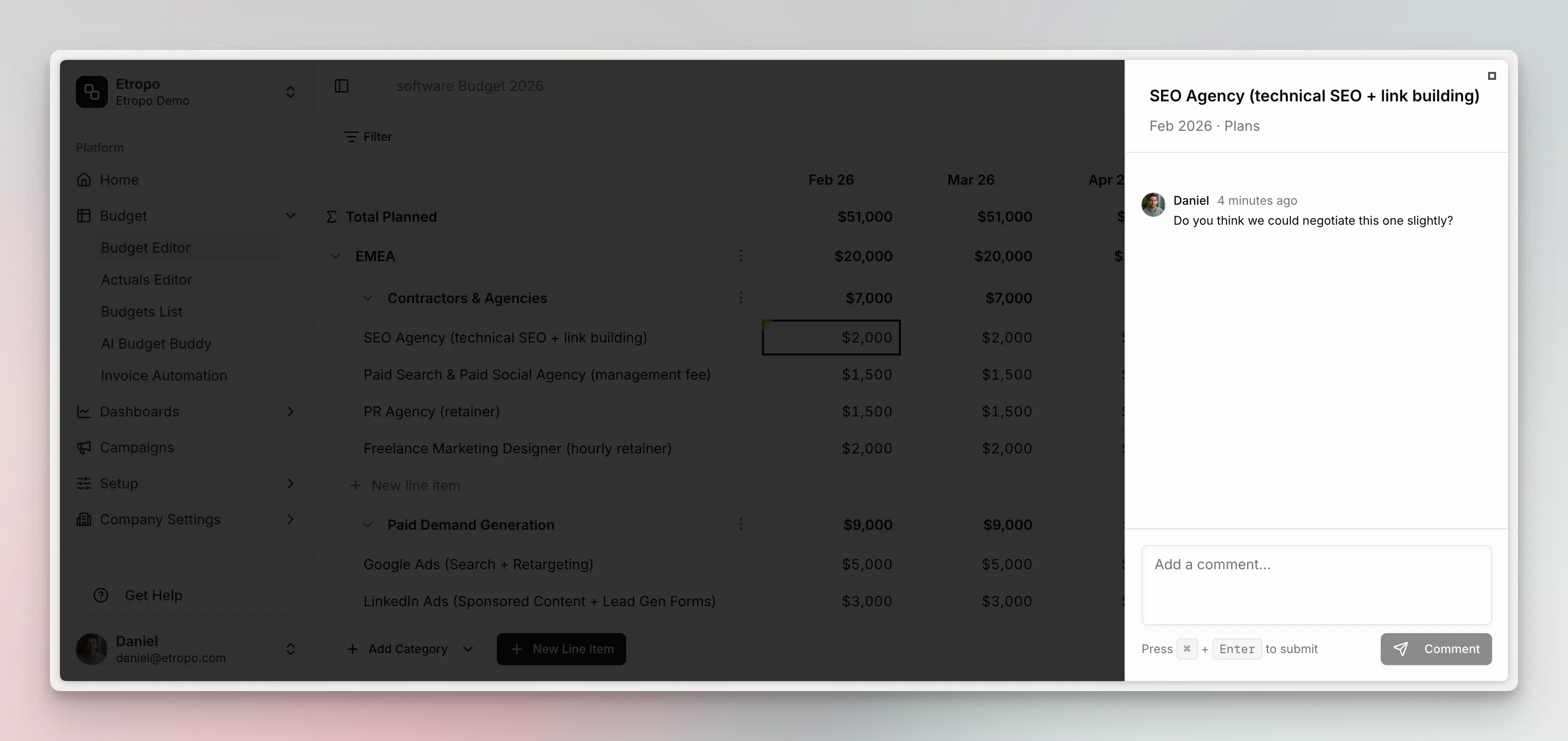
After completing all reviews, do a final check of the aggregate numbers. Verify that the total approved budget aligns with your target metrics and company growth goals. This becomes your baseline for stakeholder discussions.
Get stakeholder sign-off: CEO, board and finance
Always run first the analysis on your own and adjust budgets if anything raises your concerns. Never skip the Budget Charts Visualization before seeking approval. Missing this step often leads to major budget revisions later, damaging your credibility as CMO.
The stakeholder approval process requires two different approaches: one for the board/CEO, and another for the finance team. Each group needs specific information presented in their preferred format.
For CEO and Board - Business View
The CEO and board need a concise pitch deck visualizing the budget plan. Focus on metrics they care about: budget versus conversion growth, major category changes, and marketing spend as a percentage of total company revenue. Address potential questions proactively by including relevant charts from your budget analysis. Show clearly how your budget plan aligns with company growth targets.
For Finance Team - Technical Requirements
As covered in Learn Finance Team Rules, the finance team needs your budget in a specific technical format. Export your budget with their required line item properties:
- Cost center names and IDs
- Currency details
- VAT information
- Payment terms
- Vendor details (if applicable)
Use dedicated marketing budget tools like Etropo to generate export files matching your finance team's requirements. Or, if preferred, sync your marketing budget directly via dedicated Google Sheets integration. This saves time and reduces back-and-forth about formatting issues.
Remember that final CEO approval typically comes after the finance team reviews all department budgets. They need to evaluate marketing spend in context of the total company budget. Be prepared to wait for this broader financial review to complete before getting final signoff.
After submitting your budget, stay available for questions. Quick response times during the review period can significantly accelerate the approval timeline.
The questions finance will ask
The most common scenario is that you will get follow-up questions after submitting your budget. Prepare answers to these typical questions in advance:
| Question | Why It's Asked |
|---|---|
| Why is the headcount budget growing by X%? | Headcount is the most fixed cost - harder to reduce than pausing campaigns or ending contractor agreements. Finance needs strong justification for adding these long-term commitments. |
| Can you replace the new FTE with contractors? | Companies prefer flexible costs over fixed costs. Contractors can be terminated quickly if needed. |
| What is % of new vs existing initiatives in $? | High percentage of new initiatives means higher risk of not delivering targets. Finance prefers scaling what worked before over experimenting with new approaches. |
| Can you reduce the total budget by 10%? | Standard negotiation tactic - always have a plan for what you would cut if needed. |
| Why is your CPA target higher than last year? | Rising costs need clear explanation - market changes, competition, or strategic shifts. |
| Could you move budget from Q1 to later quarters? | Companies often want to delay spending to reduce risk and improve cash flow. |
Frequently asked questions
How do I present a marketing budget to the CFO?
- Lead with numbers, not strategy: budget versus conversion growth year over year, marketing as a percentage of revenue (typically 5 to 20% and trending down), the new versus existing initiative split, and why headcount is growing. Bring the budget exported in finance’s cost-center format and share the deck a day before the meeting.
What does finance look for in a marketing budget proposal?
- Fixed versus variable cost mix (headcount is scrutinized hardest), the share of spend on unproven new initiatives, CPA compared with last year, whether spend can be pushed to later quarters, and whether you have a plan for a 10% reduction. They also need every line item mapped to a cost center before they can consolidate department budgets.
How do I justify a marketing budget increase?
- Show that budget growth is matched by conversion growth and tied to the company revenue target, that the increase goes mostly to channels with proven CPA, and that the blended CPA is flat or falling. An increase concentrated in new bets or headcount needs an evaluation timeline of no more than one quarter per initiative.
Should I present multiple budget scenarios?
- Present one plan that matches the strategy you already agreed with the CEO. Prepare, but do not lead with, a version showing what a 10% cut would remove and its effect on targets. Multiple upfront scenarios signal unclear direction and invite the cheapest option.
How long does marketing budget approval take?
- Usually two to four weeks after submission, because finance consolidates every department’s budget before the CEO gives final approval. One or two revision rounds are normal. Fast, specific answers to follow-up questions are the main thing that shortens it.
Ready to implement your marketing budget?
Use etropo to automate your budget tracking, variance analysis, and reporting.