
Marketing Budget Categories: How to Structure Line Items and Allocate by Channel
Written by
CMO with 10+ years experience managing marketing budgets at B2B SaaS companies
Guide chapters (12)
A marketing budget is structured in five must-have categories (headcount, contractors, paid media, promotion, tools), three to eight categories in total, and line items that each carry eight properties. This chapter covers the structure, the typical percentage split between categories, how to set the total before allocating, and how to map spend across channels.
Start with a structure, not line items
Before creating any line items, establish a clear structure for your budget. This will allow you to analyze the budget later on by owner, goal, category, or any other line item property.
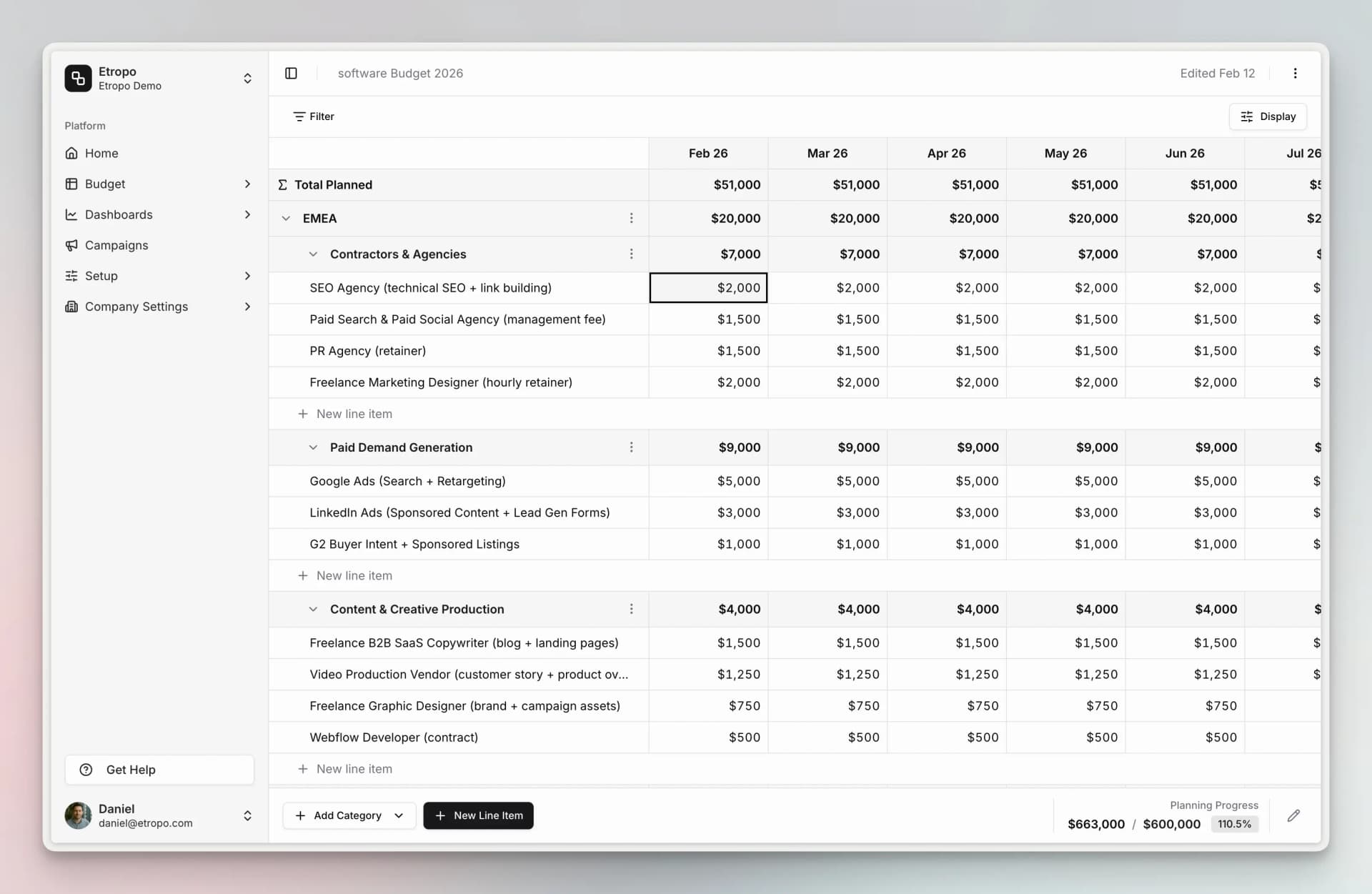
Set Up the Basics
Pick your primary budget currency and establish exchange rates upfront - align with your finance team's rates to ensure consistent company reporting.
Define your planning period in months, typically covering a 12-month span.
If you want to create multiple scenarios, choose the primary budget version to work with (if it's e.g. “optimal”, “aggressive”, “conservative”). While stakeholders might request multiple scenarios later, focus first on creating your working version that aligns with current company goals.
The five must-have marketing budget categories
You need clear categories to track different types of spending. While these often relate to company cost centers, keep them separate. Categories should reflect marketing operations and your strategy.
| Category | What It Covers |
|---|---|
| Headcount | Full-time employee salaries, including bonuses and benefits that fall under CMO planning |
| Contractors | All agency and freelancer costs supporting your growth initiatives |
| Paid Media (PPC) | Keep this separate from other promotional activities. Usually, it's the largest cost allocation in most marketing departments. It needs dedicated tracking and typically has a specific owner from your team. Learn how to calculate your PPC budget. |
| Promotion | Includes all non-PPC activities driving conversions: event marketing, PR, and influencer marketing. Most expenses here should be variable (meaning that you are able to tell how many conversions you expect of such campaigns). |
| Tools | Monthly or yearly subscriptions for marketing software and platforms |
Essential Rules for Categorization
- Keep categories between 3-8. Additional breakdowns create unnecessary complexity and make analysis impossible.
- Combine small categories. When a category represents less than 5% of total budget, merge it with a related larger category. For example, combine “Marketing Events” into “Promotion” if events are a small portion of spending.
- Avoid using an “Other” category. It's impossible to analyze a bucket of random expenses.
Additional Categories to Consider
Consider these categories if relevant for your strategy:
- Creative Production - Covers asset creation costs like studio rentals, video production, and event materials
- Detailed 'Promotion' breakdown - split promotion into PR & Events, Content Marketing, and Influencers & Sponsorships
- Travel & Entertainment - separate tracking if these costs significantly impact your budget
Typical split between categories
There is no correct split, but there is a normal one. Gartner's CMO Spend Survey divides marketing budgets into four buckets that land within a few points of each other; B2B SaaS teams that run content and demand generation in-house skew toward headcount and away from agencies.
| Category | Gartner CMO Spend Survey 2024 (all industries) | Typical B2B SaaS range |
|---|---|---|
| Headcount / labor | 24.6% | 35-50% |
| Paid media | 27.9% | 20-35% |
| Agencies / contractors | 23.7% | 10-20% |
| Tools / marketing technology | 23.8% | 8-15% |
| Promotion (events, PR, content production) | Included in the buckets above | 5-15% |
Cross-industry split from Gartner's 2024 CMO Spend Survey next to the ranges the author uses as a starting point for B2B SaaS. Gartner's four buckets sum to 100% and fold events and content production into agencies and labor.
Source: Gartner, CMO Spend Survey 2024. The benchmark that matters most is your own last-year split by category: finance will ask about any category whose share moved by more than a few points.
Plan the headcount category
Create a separate category for headcount costs. Split your workforce budget between full-time employees and contractors. During budget approval and analysis, you'll need to know what percentage of your total budget goes to FTEs (hardest to reduce) versus contractors (quickest to cut if needed).
Each marketing role must align with a clear business goal: acquisition, conversion, or retention. In a growth-driven company, most of your team should focus on acquisition activities.
The eight line item properties to track
Each line item in your budget needs specific properties assigned to track and analyze spending effectively. These properties will help you manage approvals, track spending patterns, and analyze budget allocation.
| Property | Values | Description/Tip |
|---|---|---|
| Cost Center & ID | Specific company cost center | Must align with your company's financial structure |
| Owner | Team member name | Person responsible for managing and tracking the expense |
| Currency | USD, EUR, etc. | Critical if you're located outside the USD or Eurozone and have expenses in other currencies |
| Expense Type | Variable or Fixed | Variable: Based on performance metrics (e.g., Google Ads based on CPA) Fixed: Set costs (e.g., salaries, annual subscriptions) |
| Item Continuity | New or Existing | Marks if expense existed in previous year's budget |
| Business Goal | Acquisition, Conversion, Brand, Retention, Operational | Helps analyze budget allocation across different business objectives |
| Recurring Frequency | Monthly or Yearly | Important for tools/software category to track subscription periods |
| Status | Draft, Pending Approval, Approved | Enables collaboration on your marketing budget with your team members and internal marketing approval |
Set the total budget before the line items
Before diving into specific line items, establish your overall budget target. Your approach here depends heavily on your company's growth plans and your autonomy in budget planning.
Key considerations for setting your budget targeted amount:
- Calculate your base target using Year-over-Year (YoY) growth compared to last year's budget. This gives you a rough framework for planning. Make sure it's aligned with your KPI target growth.
- Put your target budget sum into tools like Etropo. When adding line items, you'll directly see how much budget you have left to allocate. This prevents over-allocation and helps prioritize remaining expenses.
Plan line items: review existing spend, then add new
Always plan your initiatives and their business impact first, then add the resources needed to execute them - not the other way around.
Review Existing Expenses First
- Start with importing the previous year's budget. Decide which expenses to keep, reduce, or scale.
- Consider price increases, especially for software tools. Most SaaS companies raise prices annually by 10-20%. Consider this in your calculations.
- Convert monthly subscriptions to annual plans. Not only will this reduce your internal administrative work, but also many tools offer significant discounts for yearly packages, specifically during Black Friday sales in November.
Add new line items
Focus first on new channels and experiments you want to test. Map out marketing initiatives and campaigns before deciding on additional headcount or contractor needs.
Map your channels and allocate by channel
Start by analyzing your existing conversion sources. Use your CRM, BI tools, or Google Analytics to understand your key existing marketing channels.
Your marketing channels might include:
Search, Social & Display
SEO & Content Marketing
Trade shows, Conferences & Meetups
Affiliates & Partner Programs
Document Channel Performance
For each existing channel, document the following metrics:
- Last year conversion volume
- Channel CPA
- Scalability constraints
- Resources needed
Look beyond just conversion numbers. Sometimes channels with higher CPAs deliver better quality leads that convert at higher rates.
Identify new initiatives and channels
Research potential new channels for next year's investments. Consider:
- Where your target audience spends time
- What competitors are using successfully
- New platforms or ad formats
- Emerging marketing tactics
- Entering new markets with localized marketing
Remember: Focus on channels that can meaningfully impact your key conversion metric. It's better to focus on fewer channels than to spread resources too thin.
Need a starting point? Use one of our industry-specific marketing budget templates with pre-built channel allocations for B2B SaaS, e-commerce, healthcare, and more.
Frequently asked questions
What categories should a marketing budget include?
- Five categories cover most marketing teams: headcount (salaries, bonuses, benefits), contractors (agencies and freelancers), paid media, promotion (events, PR, influencers and other non-PPC conversion activity) and tools. Add creative production or travel only if they are material. Keep the total between three and eight and avoid an “Other” category.
What percentage of a marketing budget should go to each category?
- Gartner’s 2024 CMO Spend Survey puts the split at roughly 28% paid media, 25% labor, 24% agencies and 24% marketing technology. B2B SaaS teams that run their own content and demand generation usually skew heavier on headcount (35 to 50%) and lighter on agencies (10 to 20%), with paid media at 20 to 35% and tools at 8 to 15%. Your last-year split by category is the benchmark that matters most.
How is a marketing budget broken down?
- By category first, then by line item. Each line item carries the properties you will analyze on later: cost center, owner, currency, fixed or variable, new or existing, business goal, recurring frequency and approval status. That lets you answer questions like “how much goes to new initiatives?” or “what share is fixed cost?” without rebuilding the spreadsheet.
What is the difference between marketing budget categories and cost centers?
- Cost centers are finance’s tracking codes for the general ledger; categories reflect how marketing operates and decides. Keep them separate, assign every line item to a cost center so the budget exports cleanly, and do not let the cost center list dictate your day-to-day categories.
How should I allocate marketing budget across channels?
- Start from last year’s conversion volume and CPA per channel, note each channel’s scalability limit and resource needs, then fund the channels that can move your single key metric. Keep new channels and experiments clearly labelled as new initiatives; finance reads a high share of new spend as risk, so pair every experiment with an evaluation timeline.
Ready to implement your marketing budget?
Use etropo to automate your budget tracking, variance analysis, and reporting.