Marketing Experts Worth Following in 2027
Grouped by what each person actually covers: brand science, measurement, B2B GTM, positioning, AI search, growth, performance creative, martech and content. Every current role and outbound link was checked against a primary source rather than copied from another list.
42 People Listed | Last updated: August 2026
Plain-text version of this page, for AI agents and scripts: /resources/marketing-experts-to-follow.md
| Name | Current role | Beat | Why follow | For | Where |
|---|---|---|---|---|---|
| Paul Roetzer | Founder and CEO, SmarterX and Marketing AI Institute | AI in Marketing | The most marketing-native AI voice — every item is framed as a decision a marketer has to make. | Both | |
| Ethan Mollick | Associate Professor, The Wharton School; co-director, Wharton Generative AI Labs | AI in Marketing | Not a marketer, and that is the point — the best available empirical work on AI and knowledge work. | Both | |
| Kipp Bodnar | Chief Marketing Officer, HubSpot | AI in Marketing | A sitting CMO of a public company thinking out loud about AI — a rare combination. | CMO / leadership | |
| Kieran Flanagan | SVP Agentic GTM and Systems, HubSpot | AI in Marketing | Building an AI-native go-to-market org in public, rather than writing think-pieces about one. | CMO / leadership | |
| Rand Fishkin | Co-founder and CEO, SparkToro | AI Search & Discovery | Called the zero-click shift early, and has the clickstream data to keep proving it. | Both | |
| Amanda Natividad | Chief Evangelist, SparkToro; founder, Zero Click Marketing | AI Search & Discovery | Turned the zero-click thesis into an actual content methodology, which Fishkin never quite did. | Practitioner | |
| Kevin Indig | Growth advisor; author, Growth Memo | AI Search & Discovery | The only person doing rigorous behavioural research on why AI search changes buyer choice, not just how to get cited. | Both | |
| Aleyda Solis | International SEO consultant and founder, Orainti | AI Search & Discovery | Has published the clearest end-to-end operating system for AI search optimisation. | Practitioner | |
| Mike King | Founder and CEO, iPullRank | AI Search & Discovery | Explains how retrieval actually works, which almost nobody else in this space attempts. | Practitioner | |
| Lily Ray | VP SEO Strategy and Research, Amsive | AI Search & Discovery | Runs the tests everyone else cites — including the ones showing AI answers can be manipulated. | Practitioner | |
| Cyrus Shepard | Founder, Zyppy SEO | AI Search & Discovery | Evidence-backed testing on brand signals and how they feed AI visibility. | Practitioner | |
| Ross Simmonds | Founder and CEO, Foundation Marketing | AI Search & Discovery | Treats AI visibility as a distribution problem, which is the read most SEOs are still missing. | Practitioner | |
| Jason Barnard | Founder, Kalicube | AI Search & Discovery | Entity and brand-understanding work that predates the AI search scramble by years. | Practitioner | |
| Chris Long | VP of Marketing, Go Fish Digital | AI Search & Discovery | Practical, testable AI-search tactics using data you already have. | Practitioner | |
| Jon Lombardo | Co-founder, Evidenza | B2B GTM & Demand | Co-authored the research that gave B2B marketing its own laws of growth, rather than borrowed FMCG ones. | CMO / leadership | |
| Peter Weinberg | Co-founder, Evidenza | B2B GTM & Demand | The other half of the B2B Institute partnership, and the better writer of the two. | CMO / leadership | |
| Dave Gerhardt | Founder, Exit Five | B2B GTM & Demand | The most useful B2B marketing community of the last five years, and he runs it in public. | Both | |
| Sam Kuehnle | VP of Marketing, Loxo | B2B GTM & Demand | Demand gen from someone currently carrying the number, not consulting on it. | Practitioner | |
| Corrina Owens | ABM advisor and consultant | B2B GTM & Demand | Account-based marketing without the platform vendor's framing. | Practitioner | |
| Ann Handley | Chief Content Officer, MarketingProfs | Content & Craft | The best writing about writing in marketing, and a masterclass in newsletter craft by demonstration. | Both | |
| Chima Mmeje | Senior Content Marketing Manager, Moz | Content & Craft | Content strategy that starts from topical authority rather than a keyword list. | Practitioner | |
| Tas Bober | B2B landing page and conversion consultant | Content & Craft | Owns the narrowest useful niche on this list: the page your paid traffic actually lands on. | Practitioner | |
| Devin Reed | Founder, The Reeder | Content & Craft | Built content functions at Gong and Clari, and is candid about what that actually took. | Both | |
| Mark Ritson | Marketing professor and founder, MiniMBA | Effectiveness & Brand Science | The sharpest available corrective to whatever marketing fad is currently being sold to your board. | CMO / leadership | |
| Byron Sharp | Director, Ehrenberg-Bass Institute, University of South Australia | Effectiveness & Brand Science | The empirical base underneath most of what the effectiveness crowd argues about. | CMO / leadership | |
| Les Binet | Group Head of Effectiveness, adam&eveDDB | Effectiveness & Brand Science | Half of the partnership that produced the 60/40 rule — still the strongest argument in a budget meeting. | CMO / leadership | |
| Peter Field | Independent marketing effectiveness consultant | Effectiveness & Brand Science | The IPA Effectiveness Databank, read out loud by the person who has spent longest inside it. | CMO / leadership | |
| Dr Grace Kite | Economist and founder of magic numbers; Marketing Week columnist | Effectiveness & Brand Science | Econometrics explained so a non-analyst can act on it — the rarest skill on this list. | Both | |
| Tom Roach | VP Brand Strategy, Jellyfish | Effectiveness & Brand Science | The best short-form writer on the brand-versus-performance argument, and the least tribal about it. | CMO / leadership | |
| Lenny Rachitsky | Author, Lenny's Newsletter and Lenny's Podcast | Growth & PLG | The default reference for product and growth, and the interview archive is the real asset. | Both | |
| Elena Verna | Head of Growth, Lovable | Growth & PLG | Writing the AI-native growth playbook from inside one of the fastest-growing companies of the cycle. | Both | |
| Kyle Poyar | Author, Growth Unhinged | Growth & PLG | The source of the SaaS benchmarks everyone else ends up quoting. | Both | |
| Natalie Marcotullio | Head of Growth and Operations, Navattic | Growth & PLG | Freemium and self-serve mechanics from someone shipping them weekly. | Practitioner | |
| Scott Brinker | VP Platform Ecosystem at HubSpot; editor, chiefmartec | Martech & Marketing Ops | The only person credibly tracking the shape of the entire martech market, annually, for 15 years. | Both | |
| Darrell Alfonso | Director of Marketing Strategy and Operations, Indeed | Martech & Marketing Ops | Marketing ops explained by someone who has run it at AWS scale and can still write plainly. | Practitioner | |
| Dara Denney | Performance creative consultant; Chief Evangelist, Motion | Performance Creative & Paid | Codified creative strategy as a discipline, and teaches it in public for free. | Practitioner | |
| Barry Hott | Growth and creative consultant | Performance Creative & Paid | The "ugly ads" case, argued by someone who has spent $600M+ proving it. | Practitioner | |
| Sarah Levinger | Consumer behaviour analyst and performance creative consultant | Performance Creative & Paid | Creative strategy grounded in behavioural science rather than pattern-matching last quarter's winners. | Practitioner | |
| Taylor Holiday | CEO, Common Thread Collective | Performance Creative & Paid | Will take apart your ROAS assumptions in public, with the arithmetic attached. | CMO / leadership | |
| April Dunford | Founder and CEO, Ambient Strategy | Positioning & Product Marketing | The most-cited single voice in B2B positioning, and low-volume enough that everything is worth reading. | Both | |
| Emily Kramer | Co-founder, MKT1 | Positioning & Product Marketing | The best writing anywhere on how to structure and staff a marketing team. | CMO / leadership | |
| Diane Wiredu | Founder, Lion Words | Positioning & Product Marketing | Messaging as a discipline with a method, rather than a copywriting flourish. | Practitioner |
Everyone on the list, by beat
What each person actually covers, what you get in the feed, and where to follow them.
Effectiveness & Brand Science
Mark Ritson
CMO / leadership · best on LinkedInMarketing professor and founder, MiniMBA
The sharpest available corrective to whatever marketing fad is currently being sold to your board.
Ritson spent 25 years teaching MBA marketing at London Business School, MIT Sloan and Melbourne Business School before going full-time on the MiniMBA courses. He is abrasive on purpose, and that is the value: he is one of the few people with the credentials and the appetite to say publicly that a popular idea is unsupported. His columns now run across Marketing Week and Adweek, which launched a US MiniMBA portal with him.
What you actually get
- Teardowns of campaigns and category strategy that name names
- A running argument with the marketing industry about what the evidence actually shows
- The clearest available explanation of segmentation, targeting and positioning as a sequence
Where to follow
Known for: MiniMBA in Marketing; long-running columns in Marketing Week and Adweek
Role and links verified August 13, 2026.
Byron Sharp
CMO / leadership · best on LinkedInDirector, Ehrenberg-Bass Institute, University of South Australia
The empirical base underneath most of what the effectiveness crowd argues about.
Sharp has directed the Ehrenberg-Bass Institute since 1995. Mental and physical availability, distinctive brand assets, and the case against heavy loyalty-first strategy all trace back through his and the Institute's work. He and Ritson shared a stage at Cannes in June 2026 and agreed on more than the industry expected — mental availability, distinctive assets, sophisticated mass marketing, and running campaigns for years rather than weeks. That consensus is the current centre of gravity in the field.
What you actually get
- New Ehrenberg-Bass research, including its more recent B2B work, posted as it lands
- Blunt corrections when a popular framework misreads the underlying data
- Packaging and distinctive-asset examples pulled from real category research
Where to follow
Known for: How Brands Grow
Role and links verified August 13, 2026.
Les Binet
CMO / leadership · best on LinkedInGroup Head of Effectiveness, adam&eveDDB
Half of the partnership that produced the 60/40 rule — still the strongest argument in a budget meeting.
Binet is an econometrician by training who has spent his career measuring what advertising actually does to sales. With Peter Field he wrote The Long and the Short of It, whose brand-building versus activation split is the single most quoted finding in modern marketing effectiveness. Follow him for the ongoing refinement of that work rather than the headline ratio, which gets misapplied constantly.
What you actually get
- Econometric evidence on short-term versus long-term advertising effects
- Corrections to lazy readings of the 60/40 split
- Measurement methodology arguments, usually with the data attached
Where to follow
Known for: The Long and the Short of It (with Peter Field)
Role and links verified August 13, 2026.
Peter Field
CMO / leadership · best on LinkedInIndependent marketing effectiveness consultant
The IPA Effectiveness Databank, read out loud by the person who has spent longest inside it.
Field spent 15 years as a strategic planner before two decades as an effectiveness consultant, and is an Honorary Fellow of the IPA. His long-running analysis of the IPA Effectiveness Databank is the evidence behind most claims about the commercial value of creativity, and the reason "creative campaigns work harder" is a measured finding rather than an agency talking point.
What you actually get
- Analysis drawn from large case-study databases rather than single campaigns
- The link between creative quality and commercial effect
- Recession and downturn advertising evidence — useful when budgets are being cut
Where to follow
Known for: IPA Effectiveness Databank research; The Long and the Short of It (with Les Binet)
Role and links verified August 13, 2026.
Dr Grace Kite
Both · best on LinkedInEconomist and founder of magic numbers; Marketing Week columnist
Econometrics explained so a non-analyst can act on it — the rarest skill on this list.
Kite has a PhD in economics, 25 years of econometrics behind her, and sits on the IPA's effectiveness leadership group. She built, scaled and sold the analytics consultancy magic numbers. What makes her worth following over other modellers is that she translates: her charts are built to be understood by the person who has to defend the budget, not by another economist.
What you actually get
- Monthly charts on how marketing investment is actually behaving across the market
- Practical guidance on brand building inside a performance-dominated budget
- Measurement advice pitched at teams too small to run full econometrics
Tom Roach
CMO / leadership · best on LinkedInVP Brand Strategy, Jellyfish
The best short-form writer on the brand-versus-performance argument, and the least tribal about it.
Two decades across AMV BBDO, BBH, Leo Burnett and adam&eveDDB before joining Jellyfish, with IPA and Cannes effectiveness awards for McDonald's, Barclays and John Lewis. Roach occupies useful ground: he takes the effectiveness evidence seriously without treating digital and performance channels as the enemy, which makes him the most quotable person on this list when you need to end a brand-versus-performance fight internally.
What you actually get
- Essays that resolve rather than restage the brand/performance argument
- Practical brand strategy for teams whose spend is mostly digital
- Clear writing on what modern effectiveness looks like in practice
B2B GTM & Demand
Jon Lombardo
CMO / leadership · best on LinkedInCo-founder, Evidenza
Co-authored the research that gave B2B marketing its own laws of growth, rather than borrowed FMCG ones.
Lombardo spent years running research and development at LinkedIn's B2B Institute with Peter Weinberg, where their work popularised the 95-5 rule — that only about 5% of business buyers are in market at any moment. Les Binet has called the pair "the Binet and Field of B2B". They now run Evidenza, whose synthetic research angle is explicitly aimed at producing marketing plans a finance team will accept.
What you actually get
- B2B-specific growth evidence, not consumer research with the labels swapped
- The case for buying attention ahead of demand rather than harvesting it
- Arguments built to survive contact with a CFO
Where to follow
Known for: The 95-5 rule; LinkedIn B2B Institute research
Role and links verified August 13, 2026.
Peter Weinberg
CMO / leadership · best on LinkedInCo-founder, Evidenza
The other half of the B2B Institute partnership, and the better writer of the two.
Ten years at LinkedIn, where he co-founded the B2B Institute and served as its global head of development. His research has been carried by Marketing Week, Adweek, WARC and The Drum. Worth following separately from Lombardo because he posts more of the underlying reasoning and less of the conclusion.
What you actually get
- Long-form arguments about brand, memory and B2B category entry points
- Where AI actually changes B2B research and planning, from someone selling into it
- Marketing Week columns on evidence-led B2B
Dave Gerhardt
Both · best on LinkedInFounder, Exit Five
The most useful B2B marketing community of the last five years, and he runs it in public.
Former VP Marketing at Drift and CMO at Privy, now running Exit Five — a paid community of several thousand B2B marketers with a podcast, newsletter and events attached. The community is the real asset; his feed is the front door to it. Follow him for the operating reality of a mid-size B2B marketing team rather than for frameworks.
What you actually get
- How B2B marketing teams actually spend their week
- Career and team-building advice for marketing leaders below the enterprise tier
- Honest commentary on what is and is not working in B2B content right now
Where to follow
Known for: Exit Five
Role and links verified August 13, 2026.
Sam Kuehnle
Practitioner · best on LinkedInVP of Marketing, Loxo
Demand gen from someone currently carrying the number, not consulting on it.
Ex-Refine Labs, now running marketing at Loxo. Kuehnle posts the thing most demand-gen commentary leaves out: what happened when the tactic was actually run, including the failures. Particularly good on attribution's limits and on why pipeline sourced by marketing is a harder number than it looks.
What you actually get
- Attribution and reporting reality checks
- Paid social and demand-gen tests with the results attached
- The operator's view of budget allocation across a small team
Corrina Owens
Practitioner · best on LinkedInABM advisor and consultant
Account-based marketing without the platform vendor's framing.
Previously at Gong and Navattic, now advising on ABM independently. ABM commentary is unusually captured by the tools that sell it; Owens is one of the few consistent voices treating it as a coordination problem between marketing and sales rather than a software purchase.
What you actually get
- ABM programme design that does not start with buying a platform
- Marketing and sales alignment mechanics
- Target account selection and prioritisation
Positioning & Product Marketing
April Dunford
Both · best on LinkedInFounder and CEO, Ambient Strategy
The most-cited single voice in B2B positioning, and low-volume enough that everything is worth reading.
Dunford has positioned over 200 technology companies, including Google, IBM and Epic Games, across 25 years leading marketing, product and sales teams. Obviously Awesome is the standard reference on product positioning; Sales Pitch extends it into the sales conversation. She posts rarely, which on a platform optimised for volume is itself a recommendation.
What you actually get
- Positioning methodology you can run as a workshop, not just admire
- Why differentiated products still lose to worse-positioned competitors
- The link between positioning and the actual sales conversation
Where to follow
Known for: Obviously Awesome; Sales Pitch
Role and links verified August 13, 2026.
Emily Kramer
CMO / leadership · best on NewsletterCo-founder, MKT1
The best writing anywhere on how to structure and staff a marketing team.
Most marketing advice tells you what to do. Kramer's MKT1 work tells you who should do it, in what order you should hire them, and what the org chart should look like at each stage — the questions a first-time VP of Marketing actually has and can rarely find answered. Templates and frameworks are unusually concrete.
What you actually get
- Marketing org design and hiring sequence by company stage
- Budget and headcount allocation for early and growth-stage teams
- Go-to-market planning templates that are genuinely reusable
Where to follow
Known for: MKT1 Newsletter
Role and links verified August 13, 2026.
Diane Wiredu
Practitioner · best on LinkedInFounder, Lion Words
Messaging as a discipline with a method, rather than a copywriting flourish.
Wiredu works on the gap between positioning and the words that end up on the page — the place most B2B companies leak the most value. Useful counterpart to Dunford: where Dunford settles what you are, Wiredu settles how that gets said consistently across a site, a deck and a campaign.
What you actually get
- Message hierarchy and value proposition development
- Why message inconsistency across channels costs conversion
- Copy critique with the reasoning shown
AI Search & Discovery
Rand Fishkin
Both · best on LinkedInCo-founder and CEO, SparkToro
Called the zero-click shift early, and has the clickstream data to keep proving it.
Fishkin founded Moz, then SparkToro, and has spent the last several years documenting the structural collapse of click-through from search — the trend that turned out to define this decade for marketing. He argues from data rather than anecdote, and is unusually willing to publish findings that are bad for his own product category.
What you actually get
- Clickstream research on how people actually search and where attention goes
- Audience research methodology — where your buyers already are
- Blunt commentary on platform behaviour and publisher economics
Where to follow
Known for: SparkToro; zero-click search research
Role and links verified August 13, 2026.
Amanda Natividad
Practitioner · best on LinkedInChief Evangelist, SparkToro; founder, Zero Click Marketing
Turned the zero-click thesis into an actual content methodology, which Fishkin never quite did.
Natividad co-created the zero-click content framework with Fishkin in 2022 and has since built it into its own podcast and consultancy, with a book due this autumn. Where the diagnosis is "clicks are gone", her work is the prescription: how to structure content that pays for itself on the platform it is published on.
What you actually get
- Zero-click content structure — value delivered before the link
- Practical distribution across LinkedIn, newsletters and social
- Content strategy for a search environment that no longer sends traffic
Where to follow
Known for: Zero Click Marketing
Role and links verified August 13, 2026.
Kevin Indig
Both · best on NewsletterGrowth advisor; author, Growth Memo
The only person doing rigorous behavioural research on why AI search changes buyer choice, not just how to get cited.
Indig led SEO and growth at Shopify, G2 and Atlassian before going independent. Growth Memo is the most consistently rigorous publication in the AI-search space, largely because he runs studies instead of collecting anecdotes — his work on how users behave in front of an AI answer, and on brand strength as a citation driver, is the closest thing the field has to primary research.
What you actually get
- Original studies on AI search behaviour and citation patterns
- The commercial consequences of AI visibility, not just the tactics
- Deep dives on how specific high-growth companies actually grew
Where to follow
Known for: Growth Memo
Role and links verified August 13, 2026.
Aleyda Solis
Practitioner · best on LinkedInInternational SEO consultant and founder, Orainti
Has published the clearest end-to-end operating system for AI search optimisation.
Solis has built what most of the AI-search commentary lacks: a complete process. Her AI Search Optimization checklist moves a team from diagnosing visibility, through analysing which sources the engines are drawing on, to implementation and recurring validation. If you need one person to hand to a team that has to do this work rather than talk about it, it is her.
What you actually get
- Step-by-step AI search and SEO frameworks, published free
- Measurement models for AI visibility across engines
- International and technical SEO depth
Mike King
Practitioner · best on LinkedInFounder and CEO, iPullRank
Explains how retrieval actually works, which almost nobody else in this space attempts.
King takes a systems-level view of AI search: query fan-out, passage-level retrieval, and what information retrieval literature says about how these engines select sources. It is the most technically demanding material on this list and the most durable, because it describes mechanisms rather than current behaviour.
What you actually get
- Technical explanations of how AI engines retrieve and rank passages
- Analysis grounded in information retrieval research
- Practical implications for site architecture and content structure
Lily Ray
Practitioner · best on LinkedInVP SEO Strategy and Research, Amsive
Runs the tests everyone else cites — including the ones showing AI answers can be manipulated.
Ray does forensic, adversarial testing of AI search: what gets cited, what does not, and how easily the engines can be fed bad information. Her work on AI "gullibility" is some of the only research treating these systems as things to be probed rather than optimised for, which makes it valuable for risk assessment as much as for visibility.
What you actually get
- Controlled experiments on AI citation behaviour
- Google algorithm update analysis with data behind it
- E-E-A-T and quality guidelines, read closely
Cyrus Shepard
Practitioner · best on WebsiteFounder, Zyppy SEO
Evidence-backed testing on brand signals and how they feed AI visibility.
Shepard runs data-driven studies rather than opinion pieces, with a particular focus on how brand strength translates into visibility in AI-generated answers — increasingly the mechanism that decides who gets cited. Listed here with his own site rather than a social profile because more than one plausible LinkedIn profile for him is in circulation and we could not confirm which is primary.
What you actually get
- Large-sample SEO studies with methodology published
- Brand signal research as it relates to AI Overviews and answer engines
- Title tag, internal linking and on-page testing
Ross Simmonds
Practitioner · best on LinkedInFounder and CEO, Foundation Marketing
Treats AI visibility as a distribution problem, which is the read most SEOs are still missing.
Simmonds runs Foundation, a B2B content agency, and has spent years arguing that creating content is the cheap part and distributing it is the job. That framing has aged well: he was early to Reddit as a driver of both organic and AI-sourced discovery, which is now visible in citation data across the engines.
What you actually get
- Content distribution playbooks, channel by channel
- Reddit and community-driven discovery
- Repurposing and content-engine mechanics for B2B
Jason Barnard
Practitioner · best on LinkedInFounder, Kalicube
Entity and brand-understanding work that predates the AI search scramble by years.
Barnard has been working on how search engines understand entities — who you are, what you do, what you are associated with — since long before answer engines made it urgent. His Entity Home concept and the frameworks around it are the practical answer to "how do we make the machines describe us correctly", which is now a board-level question.
What you actually get
- Entity SEO and knowledge graph mechanics
- How to correct what AI engines say about your brand
- Personal and executive brand as a machine-readable problem
Chris Long
Practitioner · best on LinkedInVP of Marketing, Go Fish Digital
Practical, testable AI-search tactics using data you already have.
Long's most useful contribution is mining prompt-shaped queries out of Google Search Console — a way to find AI-search intent without buying another tool. He runs controlled experiments on citation and publishes the results, which puts him in a small group of people producing evidence rather than predictions.
What you actually get
- Search Console techniques for finding AI-era intent
- Controlled tests on what earns citations
- Technical SEO diagnostics
Growth & PLG
Lenny Rachitsky
Both · best on NewsletterAuthor, Lenny's Newsletter and Lenny's Podcast
The default reference for product and growth, and the interview archive is the real asset.
Lenny's Newsletter is the largest business publication on Substack, and the podcast has become the standard venue for growth and product leaders to explain what they actually did. It is more product than marketing, but the growth, pricing and positioning episodes are directly applicable, and the back catalogue functions as a reference library.
What you actually get
- Long-form interviews with operators who ran the thing being discussed
- Growth, pricing and PLG benchmarks
- Career and team advice for senior operators
Where to follow
Known for: Lenny's Newsletter; Lenny's Podcast
Role and links verified August 13, 2026.
Elena Verna
Both · best on NewsletterHead of Growth, Lovable
Writing the AI-native growth playbook from inside one of the fastest-growing companies of the cycle.
Verna held growth leadership roles at Miro, SurveyMonkey, Amplitude and Dropbox before joining Lovable, which reached roughly $200M ARR in under a year with about 100 people. That vantage point is the reason to follow her now rather than for the PLG frameworks she is already known for: she is describing a growth model as it forms, including the parts that contradict the last decade of advice.
What you actually get
- How AI-native companies grow differently — innovation over optimisation
- Product-led growth and product-led sales mechanics
- Honest accounting of growth tactics that do not work
Where to follow
Known for: Elena's Growth Scoop
Role and links verified August 13, 2026.
Kyle Poyar
Both · best on NewsletterAuthor, Growth Unhinged
The source of the SaaS benchmarks everyone else ends up quoting.
Poyar spent 15 years at OpenView helping software companies scale from $1M to $100M+ ARR, and Growth Unhinged now reaches tens of thousands of operators. He publishes actual benchmark data on pricing, packaging and go-to-market efficiency — which is why his charts turn up, usually uncredited, in other people's board decks.
What you actually get
- SaaS pricing and packaging benchmarks
- Go-to-market efficiency data across company stages
- PLG motion design and where it breaks
Where to follow
Known for: Growth Unhinged
Role and links verified August 13, 2026.
Natalie Marcotullio
Practitioner · best on LinkedInHead of Growth and Operations, Navattic
Freemium and self-serve mechanics from someone shipping them weekly.
Marcotullio runs growth at Navattic and posts the operational detail that growth commentary usually skips — what the experiment was, what it cost, what actually moved. Particularly good on interactive demos and on the practical question of what to put in front of a buyer before they will talk to sales.
What you actually get
- Freemium and self-serve conversion experiments with results
- Website and demo experience optimisation
- Small-team growth marketing operations
Performance Creative & Paid
Dara Denney
Practitioner · best on LinkedInPerformance creative consultant; Chief Evangelist, Motion
Codified creative strategy as a discipline, and teaches it in public for free.
Denney has managed over $100M in Meta spend and built a six-figure YouTube following teaching creative strategy. Her methodology is the useful part: she treats ad analysis as content analysis — creator, message, persona, imagery — rather than metrics analysis, and separates primary KPIs from what she calls storytelling KPIs. In a year where creative quality outweighs targeting on paid social, this is the most directly applicable material on the list.
What you actually get
- Teardowns of winning Meta ads with the reasoning shown
- How to structure and staff a performance creative team
- Creative testing frameworks that survive contact with a real budget
Barry Hott
Practitioner · best on LinkedInGrowth and creative consultant
The "ugly ads" case, argued by someone who has spent $600M+ proving it.
Hott has managed over $600 million in social ad spend across AT&T, Toyota, Kraft and Microsoft before moving to DTC growth. His central argument — that polished studio creative routinely loses to deliberately rough, native-looking ads — has become consensus, and he was making it before it was.
What you actually get
- Paid social creative concepts and why they work
- Landing page and CRO work tied to the ad that drove the click
- Practical account structure and testing advice
Sarah Levinger
Practitioner · best on LinkedInConsumer behaviour analyst and performance creative consultant
Creative strategy grounded in behavioural science rather than pattern-matching last quarter's winners.
Levinger has spent years on consumer psychology and behavioural science applied to performance creative, working with DTC brands including Fabletics and Kettle & Fire. She is the counterweight to teardown-driven creative strategy: her work explains why an ad worked at the level of motivation and identity, which is what makes it repeatable.
What you actually get
- Psychological frameworks behind high-performing creative
- Customer research that feeds directly into ad concepts
- Why creative that tested well still failed
Taylor Holiday
CMO / leadership · best on LinkedInCEO, Common Thread Collective
Will take apart your ROAS assumptions in public, with the arithmetic attached.
Holiday runs Common Thread Collective, an ecommerce growth agency. He is analytically aggressive in a way that is rare among agency principals — publishing the finance behind ecommerce growth, arguing about contribution margin instead of ROAS, and being specific about what agencies are and are not worth. Most valuable if you own a P&L rather than a channel.
What you actually get
- Ecommerce unit economics and forecasting
- The case against ROAS as a decision metric
- Media buying strategy tied to actual profitability
Martech & Marketing Ops
Scott Brinker
Both · best on WebsiteVP Platform Ecosystem at HubSpot; editor, chiefmartec
The only person credibly tracking the shape of the entire martech market, annually, for 15 years.
Brinker publishes the martech landscape — the map everyone screenshots. The 2026 edition is the interesting one: the market effectively stopped growing, up 0.79% to 15,505 products, while churning hard underneath with 1,488 products added and 1,367 removed. His current argument is that 2026 shifts the question from AI for marketers to AI for customers, which changes what your stack is for.
What you actually get
- The annual martech landscape and what its shape means
- Platform ecosystem and integration strategy
- Where agentic AI actually lands in the marketing stack
Where to follow
Known for: The Marketing Technology Landscape
Role and links verified August 13, 2026.
Darrell Alfonso
Practitioner · best on LinkedInDirector of Marketing Strategy and Operations, Indeed
Marketing ops explained by someone who has run it at AWS scale and can still write plainly.
Alfonso led marketing operations at AWS for nearly four years and now directs marketing strategy and operations at Indeed. Marketing ops is chronically under-served by public writing — most of it is vendor content — and The Martech Handbook plus his weekly posts are the most reliable substitute for a mentor in the discipline.
What you actually get
- Martech stack architecture and governance
- Marketing operations process design and team structure
- Career guidance for a function with no obvious ladder
Where to follow
Known for: The Martech Handbook
Role and links verified August 13, 2026.
AI in Marketing
Paul Roetzer
Both · best on LinkedInFounder and CEO, SmarterX and Marketing AI Institute
The most marketing-native AI voice — every item is framed as a decision a marketer has to make.
Roetzer sold his agency in 2021 and now runs the Marketing AI Institute and SmarterX. What separates him from general AI commentary is translation: he does not report that a model shipped, he reports what it changes about your team, your workflow and your budget. Also runs MAICON and the Artificial Intelligence Show podcast.
What you actually get
- Weekly AI news filtered for what actually affects marketing work
- AI adoption and literacy planning at an organisational level
- Realistic assessment of what agentic tools can and cannot do yet
Where to follow
Known for: Marketing Artificial Intelligence; The Artificial Intelligence Show
Role and links verified August 13, 2026.
Ethan Mollick
Both · best on NewsletterAssociate Professor, The Wharton School; co-director, Wharton Generative AI Labs
Not a marketer, and that is the point — the best available empirical work on AI and knowledge work.
Mollick studies the effects of AI on work, entrepreneurship and education at Wharton, and One Useful Thing has become the most widely shared practitioner AI writing of the last two years. He runs and reports actual experiments on what AI does to output quality and team performance, which is more useful for planning than any amount of marketing-specific AI commentary. Listed with his newsletter rather than a social profile because that is where the substance is.
What you actually get
- Experimental findings on AI's effect on knowledge work quality and speed
- Practical prompting and workflow guidance grounded in testing
- Sober assessment of frontier model capability as it changes
Where to follow
Known for: Co-Intelligence; One Useful Thing
Role and links verified August 13, 2026.
Kipp Bodnar
CMO / leadership · best on LinkedInChief Marketing Officer, HubSpot
A sitting CMO of a public company thinking out loud about AI — a rare combination.
Bodnar sets HubSpot's global marketing strategy and co-hosts Marketing Against the Grain with Kieran Flanagan. Most CMO content at this level is sanitised; his is not, largely because the podcast format lets him work through problems rather than present conclusions. He and Flanagan co-wrote Loop, a marketing framework for the AI era.
What you actually get
- How a large marketing organisation is actually adopting AI
- The search-to-answer-engine shift from a company with a lot at stake in it
- Marketing Against the Grain, weekly
Where to follow
Known for: Marketing Against the Grain; Loop
Role and links verified August 13, 2026.
Kieran Flanagan
CMO / leadership · best on LinkedInSVP Agentic GTM and Systems, HubSpot
Building an AI-native go-to-market org in public, rather than writing think-pieces about one.
Flanagan was SVP of Marketing at HubSpot, then CMO at Zapier, and is now back at HubSpot running Agentic GTM and Systems. The remit is the reason to follow him: he owns the build of the agentic go-to-market motion, so what he posts is implementation detail rather than prediction.
What you actually get
- What an AI-native GTM org looks like in practice
- AI fluency and workflow design for marketing teams
- Growth and distribution strategy in an AI-mediated buying process
Where to follow
Known for: Marketing Against the Grain; Loop
Role and links verified August 13, 2026.
Content & Craft
Ann Handley
Both · best on NewsletterChief Content Officer, MarketingProfs
The best writing about writing in marketing, and a masterclass in newsletter craft by demonstration.
Handley co-founded ClickZ, has built two multimillion-dollar companies, and writes Total Annarchy fortnightly. The newsletter is worth subscribing to twice over: once for the advice, once to study how it is constructed. In a period where most marketing content is being generated rather than written, she is the strongest argument for the difference.
What you actually get
- Writing craft applied to marketing, concretely
- Newsletter strategy demonstrated rather than described
- A consistent human voice as a competitive position
Where to follow
Known for: Everybody Writes; Total Annarchy
Role and links verified August 13, 2026.
Chima Mmeje
Practitioner · best on LinkedInSenior Content Marketing Manager, Moz
Content strategy that starts from topical authority rather than a keyword list.
Mmeje works at the intersection of SEO and content strategy, and is one of the clearest voices on building topical authority — covering a subject completely enough that search engines and answer engines treat you as the source. That approach has aged particularly well as citation, rather than ranking, became the goal.
What you actually get
- Topic cluster and topical authority planning
- SEO content strategy that survived the AI transition
- Freelance and in-house content operations
Tas Bober
Practitioner · best on LinkedInB2B landing page and conversion consultant
Owns the narrowest useful niche on this list: the page your paid traffic actually lands on.
Bober works almost exclusively on B2B landing pages and conversion. It is a deliberately small remit, and the reason to follow her is that this is where a large share of paid budget quietly dies — the ad worked, the page did not, and nobody on the team owns the page. She posts teardowns with the reasoning made explicit.
What you actually get
- Landing page teardowns for B2B SaaS
- Conversion copy and layout decisions, explained
- Where paid media budget leaks after the click
Devin Reed
Both · best on LinkedInFounder, The Reeder
Built content functions at Gong and Clari, and is candid about what that actually took.
Reed ran content at Gong during the period its content became the thing every B2B company tried to copy, then at Clari, and now advises independently. Useful for the operating detail behind a content brand: how much was produced, by whom, at what cost, and which parts of the reputation were downstream of a small number of decisions.
What you actually get
- Content strategy for B2B companies trying to build a category voice
- What a content team of one to five people can realistically produce
- LinkedIn as a distribution channel, from someone who did it at scale
Follow these too — they outlast the people
Individuals move on. These publish continuously, and most of the names above are drawing on them anyway.
Ehrenberg-Bass Institute
The empirical marketing science that most effectiveness argument is downstream of.
Gartner for Marketers
The annual CMO Spend Survey — the benchmark you will be measured against in a budget conversation.
chiefmartec
The annual martech landscape and ongoing analysis of where the stack is heading.
Marketing Week
Where several people on this list publish their longer arguments, Ritson and Kite included.
SparkToro
Clickstream research on search behaviour and audience discovery.
Marketing AI Institute
AI news filtered specifically for marketing decisions.
Who to follow in marketing — FAQ
Common questions about building a follow list that is actually worth the attention it costs.
How this list is put together
Curated by working marketers, not scraped. Last verified August 13, 2026.
This list was assembled by working marketers, not scraped from other roundups or ranked by follower count. Every person here was checked individually: their current role, where they publish, and whether they are still working on the subject they became known for. Where we could not confirm which of several profiles belonged to a person, we link their own website instead of guessing at a social handle.
Someone gets on the list if
- They are actively publishing now, not coasting on work from three years ago
- They cover a definable beat you can point at, rather than general marketing commentary
- Their material contains something checkable — data, a method, a case, a study
- Their current role was confirmed against a primary source on the date shown
- They are worth the follow for the substance, independent of audience size
What we leave off
- Anyone recommended primarily because they have a large following
- People whose feed is mostly promotion for their own paid product
- Names carried over from older listicles without re-checking what they do now
- Accounts we could not confidently match to a verified profile URL
- Engagement-farming formats — the hook, the one-word-per-line post, the fake poll
On links.Every URL here was read off the person’s own site or a search result that resolved to them before it was written down. We do not construct profile URLs from name patterns: where more than one plausible profile is in circulation for someone, we link the site they control instead. A confidently wrong /in/ slug sends a reader to a stranger, which is worse than one fewer link.
Related Resources
Other things we keep verified so you don't have to.
Reading is the easy part.
Now put a number against it.
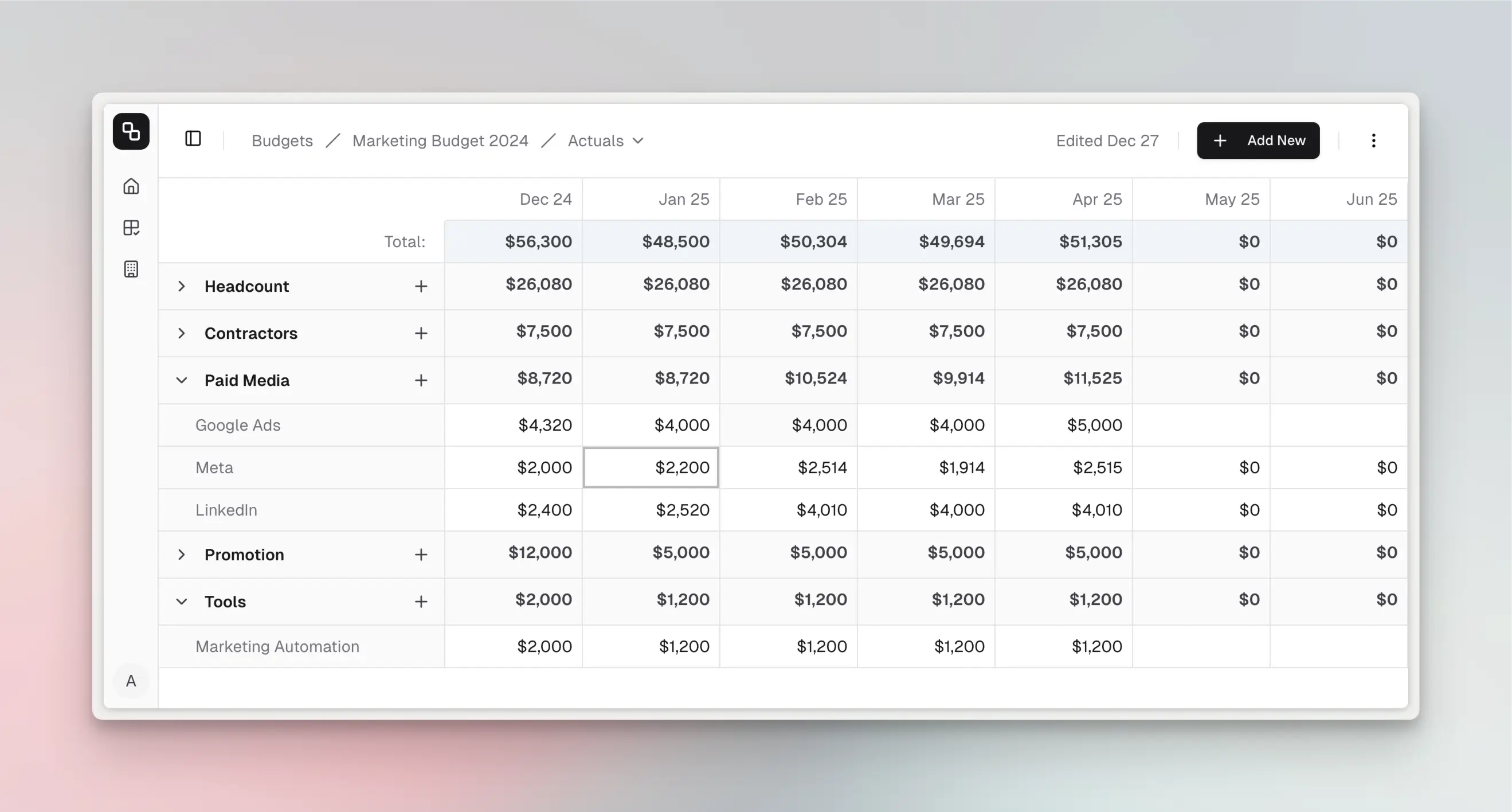
Build a complete marketing budget - channels, tools, headcount and conferences - in one place, and see what each bet is actually costing you.