
Marketing Budget Planning Process: Timeline, Milestones and Who Does What
Written by
CMO with 10+ years experience managing marketing budgets at B2B SaaS companies
Guide chapters (12)
The marketing budget planning process takes eight to ten weeks: three to four weeks of marketing work split into seven phases, followed by finance consolidation, board review and one or two revision rounds. This chapter gives you the phases, the time each one takes, a week-by-week calendar, and the rules for splitting the work across your team.
Start with last year's analysis
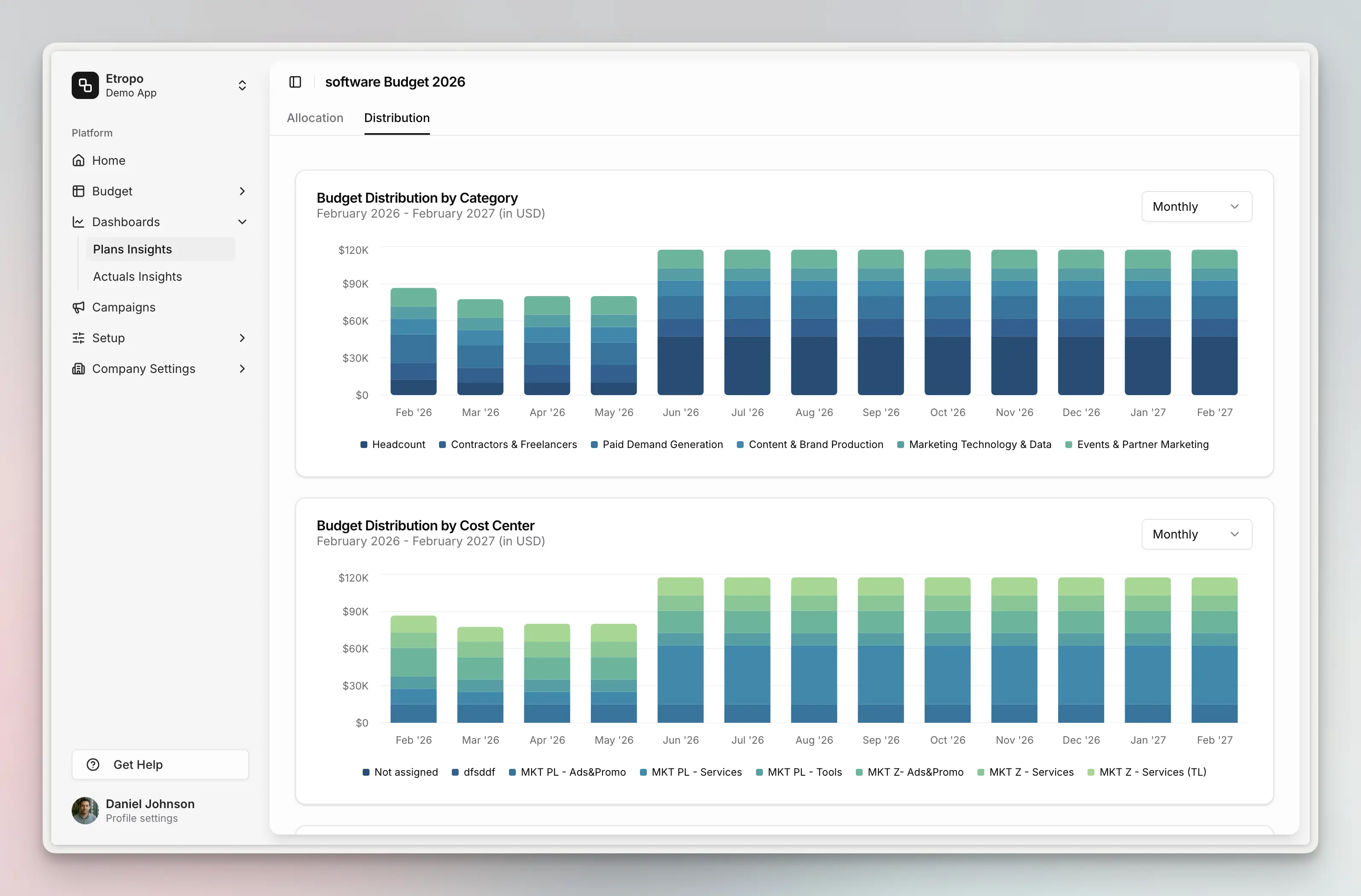
Last year's performance is your starting point for planning. Focus first on understanding the key growth and spending patterns. Review your budget versus actual spend data, both total and by category. Pay special attention to your budget growth rate year over year and how it correlates with the company's revenue growth. Check also your key conversion growth to see if spending translated into results.
Understanding last year's process will help you plan better this time. Understand the gap between how you structured your budget upfront and what really happened — track every revision from first draft to final reality. Review the feedback cycles - what type of corrections had to be done. This will help you plan your timeline better.
The budget cycle and the seven planning phases
Start by creating a visual timeline. Most companies follow a standard budget cycle:
Department Planning
HR / Finance / Board Review
Revisions
Final Signoff
Your finance team likely provides these high-level deadlines. However, you need to break down that first “Department Planning” phase into actionable steps. A structured internal planning process ensures your budget aligns with business targets and is backed by data. Each step builds on the previous one. Let's breakdown the “marketing planning” into phases.
| Phase | What to do | Outcome | Time |
|---|---|---|---|
| 1. Baseline Proposal | Project current performance forward assuming no changes. Dive into channel metrics, seasonal patterns, and known cost increases. | Forecasts and budgets for the forecasts | Up to 1 week |
| 2. Growth Initiatives Review | Create a shortlist of potential new investments. Evaluate each initiative based on impact on customer acquisition vs. resources required. | List of initiatives with impact on KPI and budget needed | 1-2 weeks |
| 3. Target Setting | Choose growth initiatives and add their impact and costs to baseline forecasts. | Target growth numbers | 2-3 days |
| 4. Resource Mapping | Map out month-by-month needs: hiring plans, tool costs, agency support. Factor in recruitment and ramp-up time. | Final budget | 2-3 days |
| 5. Plan Analysis | Go through a checklist of metrics. Analyze QoQ growth, category breakdown, and correlation with targeted conversions. | Budget visualization on graphs | 1-2 days |
| 6. Pitch Preparation | Package your plan into a compelling story showing the connection between spending and results. | Deck with strategy and investment reasoning | 2-3 days |
| 7. Submit for Signoff | Send the strategy pitch deck with visual budget analysis and raw budget file to finance. | Approved budget | — |
A 10-week marketing budget planning calendar
Working back from a January fiscal year, this is the calendar the seven phases produce once you add the review rounds finance controls. Shift everything by the offset of your own fiscal year; the sequence and the durations stay the same.
| Week | Timing (Jan FY) | Activity | Owner | Output |
|---|---|---|---|---|
| 1-2 | Mid September | Last-year analysis; strategy meeting with the CEO on growth approach, autonomy and targets | CMO | Agreed direction and target range |
| 3 | Early October | Baseline proposal: project current channels forward with known cost increases | CMO, channel owners | Baseline forecast and budget |
| 4-5 | October | Growth initiatives review: channel owners propose, CMO shortlists on one KPI | Channel owners | Shortlist with KPI impact and cost |
| 6 | Late October | Target setting and month-by-month resource mapping (hiring, tools, agencies) | CMO, HR for headcount | Draft budget with all line items |
| 7 | Early November | Plan analysis with the six budget charts; internal line-item approval | CMO | Reviewed budget, charts |
| 8 | Mid November | Pitch deck; 30-minute strategy meeting with stakeholders; submit to finance in their format | CMO | Submitted budget |
| 9-10 | Late November to early December | Finance consolidation, board review, one or two revision rounds | Finance, CEO | Approved budget |
Ten-week planning calendar for a fiscal year starting January 1. Weeks 1-8 are marketing's work; weeks 9-10 belong to finance and the board.
Delegate planning duties to channel owners
Marketing budgets require input from multiple team members. Channel owners know their numbers best - their conversion, CPA projections and cost estimations will be always more accurate than yours. Whenever possible, make your team members line items or even categories owner. This will help you speed up with the process and build the culture of collaborative ownership.
Get rid of multiple planning spreadsheets
The biggest problem faced by CMOs: running budget planning through multiple spreadsheets. One for headcount costs, another shared with finance, and separate one shared with your marketing team. That makes consolidation a nightmare. Use a single budgeting tool like Etropo that supports collaboration and category access control. Your team members input their numbers directly, with restricted access to sensitive data like headcount costs. Each line item should have the owner and you might have even owners for the whole category (like PPC), where all line items will be automatically assigned.
Budget versions: build one plan, use versions for trade-offs
Don't waste time creating multiple budget versions upfront. Instead, first align with your CEO and stakeholders on the core strategy approach - whether you're pursuing aggressive growth or taking a conservative path.
Still, many CEOs request multiple budget versions: conservative, balanced, and aggressive. This often leads to wasted effort as typically only one approach aligns with the company's true strategy. After all, if your company aims for aggressive growth, why spend time preparing a conservative budget that doesn't support this goal?
If you create multiple versions too early, you'll split your focus between different strategies instead of perfecting the one that matters most.
Better Approach to Budget Versions
Don't create budget versions if you're not forced to it. Use this approach instead:
Align on strategic direction first
Create one solid budget matching that strategy
Use versions later to show impact of cuts or changes
Keep detailed notes on what changes between versions
Multiple versions at the start usually mean unclear strategic direction. Push for alignment on company's growth targets before detailed budget planning. Budget versions are useful during the approval process. Use them to show trade-offs when you need to cut specific line items or adjust growth targets.
- Keep a change log per version: what moved, by how much, and the expected effect on the key metric.
- Name versions by their trigger (“-10% finance request”, “H2 reforecast”), not by adjective.
Frequently asked questions
How long does marketing budget planning take?
- Plan for eight to ten weeks from last-year analysis to final sign-off. The internal marketing work (baseline, initiatives, targets, resource mapping, analysis, pitch) takes three to four weeks; finance and board review plus one or two revision rounds take the rest. For a January fiscal year, start in mid-September.
What are the steps in the marketing budget planning process?
- Seven phases: 1) baseline proposal that projects current performance forward, 2) growth initiatives review, 3) target setting, 4) month-by-month resource mapping, 5) plan analysis with budget charts, 6) pitch preparation, 7) submission for sign-off. Phases 1 and 2 take the longest, roughly one to two weeks each.
When should marketing budget planning start?
- About three months before the fiscal year starts, and at least two weeks before finance opens the department planning window. Use that lead time for last-year analysis and the strategy conversation with your CEO, so the planning window itself is spent on numbers rather than alignment.
How many budget versions should I prepare?
- One. Agree the strategic direction (aggressive, balanced or conservative) with your CEO first and build the plan that matches it. Create additional versions only when stakeholders ask for a cut or a target change, so each version documents a specific trade-off rather than a hedge.
Who should be involved in marketing budget planning?
- The CMO owns the plan, channel owners propose and own their line items, finance supplies the format and cost-center rules, HR confirms compensation handling, and the CEO signs off on targets. Give every line item a named owner and a deadline; the fewer spreadsheets in circulation, the shorter the consolidation.
Ready to implement your marketing budget?
Use etropo to automate your budget tracking, variance analysis, and reporting.